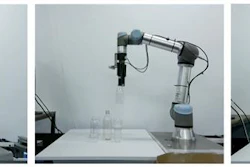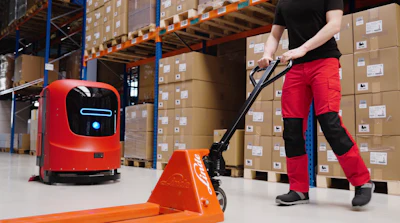
Sonair showcases the first commercial deployment of its 3D ultrasonic technology, moving robot safety from 2D sensing to full 3D spatial awareness.
ADAR (Acoustic Detection and Ranging) sensor allows autonomous machines to perceive their surroundings using sound rather than light. Built on patented technology developed at the SINTEF research institute in Norway, ADAR uses MEMS-based transducer arrays to detect people and objects in real-time. This "sound-powered" vision provides a critical new sensing layer that proves reliable, deterministic short-range distance measurements where vital safety decisions are made.
“Robots must understand the world around them reliably if they are going to work safely alongside people,” says Knut Sandven, CEO of Sonair.
Key takeaways:
· Provides full 180-degree × 180-degree field of view, with total spatial awareness to eliminate blind spots.
· By detecting obstacles at all heights and reducing "false positives" from environmental factors, the sensor minimizes unnecessary stops.
· Designed specifically for dynamic environments where humans and autonomous mobile robots (AMRs) must share space closely and safely.
· By deliberately avoiding camera-based or optical sensor systems, ADAR enables autonomous robots to operate in areas with heightened security, such as military facilities or sensitive commercial sites, where the use of cameras is often restricted or prohibited.