Advancements in automation are transforming warehouse operations, helping facilities improve speed, accuracy, and overall performance. Today’s innovations aren’t limited to automation hardware. The industry is also seeing a major evolution in the software that orchestrates everything behind the scenes.
Breaking down the software divide
Automation software has long been synonymous with programmable logic controllers (PLCs). These industrial computers are responsible for precisely controlling robots, conveyors, and other automated equipment throughout the warehouse. PLCs handle device-level execution, while higher-level software manages inventory, order processing, and operational planning. Both layers are essential, but they typically run as independent systems.
Now, that structure is shifting. Operations teams face growing demands around order speed, accuracy, and reliability. At the same time, automation systems themselves have expanded to include a wide range of storage, picking, transport, sortation, and shipping technologies. Gaining a competitive edge in all this complexity depends on how effectively technology, people, and processes can work together.
That’s why the most advanced warehouse control systems (WCS) now integrate device-level control with higher-level operational intelligence. One unified platform can streamline complicated software integrations, coordinate the entire distribution process in real time, and support broader business goals.
Moving beyond device-level control
PLCs are an essential part of automated logistics systems. However, they’re designed to control individual devices, not entire warehouse ecosystems. Modern WCS platforms bridge that gap. They bring all PLC-controlled equipment under one umbrella, while simultaneously connecting to higher-level WMS and ERP systems.
An integrated WCS platform coordinates everything from individual robot movements to overall material flow. First, a warehouse execution system (WES) layer receives data on inventory, order lines, fulfillment priorities, and shipping deadlines from the higher-level systems. It determines the most efficient way to achieve these objectives, while continuously optimizing workflows and resource utilization. Next, the WCS translates those decisions into real-time commands for equipment throughout the facility.
Put simply, the WES decides what work should be completed, and the WCS makes it happen. Together, they create a seamless connection between business objectives and the warehouse floor.
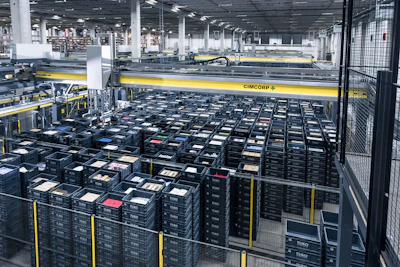
Notably, this level of orchestration isn’t limited to fully automated operations. Many warehouses are hybrid environments of automated and manual work. An integrated WCS bridges the gap, enabling technologies like automated storage and retrieval systems (AS/RS), picking systems, and automated guided vehicles (AGVs) to work together alongside people to create one fast, high-performance operation.
Aligning automation with business needs
Modern fulfillment operations face constantly changing demand patterns, shifting order structures, seasonal surges, and evolving customer expectations. Integrated WCS platforms help facilities adapt quickly by dynamically adjusting workflows in real time based on real-world conditions and business priorities.
For example, the WCS can rebalance workloads to prevent bottlenecks, reroute inventory during disruptions, and prioritize urgent orders to meet last-minute deadlines. By continuously monitoring both equipment performance and fulfillment demands, the software helps maintain throughput, accuracy, and responsiveness at all times.
Integrated software platforms also play an important role in supporting the warehouse workforce as operations become more automated. Historically, automation systems required heavy technical training to operate, maintain, and troubleshoot. But modern WCS platforms simplify the user experience. They offer intuitive dashboards, centralized monitoring, and user-friendly error management tools that help operators maintain visibility and control without deep automation expertise.
Moreover, integrated reporting and analytics capabilities provide insights that extend beyond individual machines. With access to both business data and automation data in one interface, operators and managers gain a clear picture of how decisions, workflow changes, and fulfillment priorities impact overall warehouse performance.
Building smarter, more scalable systems
Scalability and supply chain intelligence are top priorities for many organizations. A flexible, integrated WCS platform is the perfect foundation for strategic, long-term growth.
With a flexible WCS, warehouses won’t get locked into fixed infrastructure. They can easily introduce new technologies and expand automated workflows without requiring major system overhauls. This flexibility allows companies to scale automation over time while maintaining stability.
Looking ahead, emerging technologies like artificial intelligence (AI) will help WCS platforms become even more proactive and adaptive. For example, advanced analytics can identify performance trends, predict potential disruptions, and recommend adjustments before issues impact throughput.
Ultimately, the convergence of PLC-level control and high-level intelligence is creating smarter, more scalable, and future-ready distribution networks.
Key considerations for WCS implementation
When implementing a WCS to serve as the backbone of warehouse operations, companies should keep a few considerations in mind:
· Flexibility: Modular automation is on the rise, thanks to its unmatched adaptability and scalability. These systems are made up of independent yet compatible blocks of automation that can be deployed in phases, modified as needed, and expanded over time. A WCS built with modular architecture can support this flexible approach to automation, making it easier to adapt to change and scale operations.
· Resilience: A modern WCS should support both independent module control and system-wide coordination. With this design, individual modules can continue to operate independently if another module goes down or requires maintenance. This built-in redundancy minimizes disruptions and improves operational resilience.
· Cybersecurity: Automation systems no longer operate independently from the rest of the business. Modern WCS platforms are deeply connected to enterprise systems, operational data, and supply chain decision-making, making strong cybersecurity protections non-negotiable.
· Reliable support: Minimizing downtime is critical. Fast, knowledgeable support can help facilities quickly resolve issues and maximize uptime.
· Industry specifics: Different sectors deal with unique operational challenges, order profiles, and fulfillment demands. It’s important to choose software designed for these needs.
Given these factors, many companies are opting to work with automation partners that develop and support their own in-house WCS platforms. Providers with expertise across both the software and automation layers are well positioned to deliver reliable cybersecurity management, faster support, and tailored solutions that satisfy industry-specific requirements.
Intelligent software is now the cornerstone for flexible, scalable distribution operations. With an integrated WCS platform and expert support, warehouse automation evolves from a collection of machines into one synchronized solution aligned around long-term business success.