A mid-sized distributor with one regional distribution center now faces the same expectations as an e-commerce giant: fast delivery, accurate inventory, and seamless returns. In a typical week, managers review options like goods-to-person systems, autonomous mobile robots (AMRs), and AI-driven slotting. The benefits are clear. The economics are not. A multi-million-dollar automation project rarely works at their scale.
So, they do what many SMEs have always done. They add labor, extend shifts, and adjust layouts. Meanwhile, competitors are quietly plugging into automated shared facilities or subscribing to robotics they do not own. The competitive gap is no longer about scale. It is about access.
Smart warehousing, delivered as a service through 3PLs and robotics providers, is changing that equation. SMEs are no longer choosing between full automation and no automation. They are choosing how to access capabilities that were once out of reach.
Why smart warehousing-as-a-service is rising
Warehouse automation has moved beyond pilot programs and into broader adoption. And, warehouse robotics adoption is no longer limited to large enterprises. A 2025 survey by MHI and The Robotics Group found that 48% of organizations were using robotics in plants or warehouses, an increase from 23% three years earlier with more than half of respondents generating under $50 million in annual revenue.
At the same time, the business model is shifting. The share of companies using robotics-as-a-service (RaaS) or software-as-a-service (SaaS) automation increased from 46% to 64% over the same period. This reflects a move away from ownership toward subscription and usage-based access.
The core driver is flexibility. Traditional automation requires high upfront capital, long payback periods, and stable demand assumptions. Many SMEs operate under volatile demand, tight capital constraints, or evolving business models. RaaS changes the equation by converting fixed investments into variable costs. Instead of committing capital based on forecasts, firms can scale automation up or down based on actual demand.
This shift also changes the timing of value. SMEs can start small, test performance, and expand based on results rather than projections. In practice, this reduces risk and accelerates adoption. What was once a strategic investment decision becomes an operational choice.
How “as-a-service” smart warehousing works
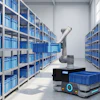
In practice, SMEs access smart warehousing through two primary models: RaaS and warehouse-as-a-service (WaaS). In a RaaS model, robotics providers deploy AMRs or other automated systems under subscription or usage-based contracts. The provider retains ownership and responsibility for maintenance, updates, and system performance. The SME pays based on usage, throughput, or time. This allows firms to treat automation more like labor, adding capacity during peak periods and scaling back when demand softens.
In WaaS models, 3PLs operate shared facilities that are often highly automated. SMEs pay for storage, handling, and fulfillment on a per-unit or per-order basis. As 3PLs invest in robotics, AI, and advanced WMS platforms, their customers benefit from those capabilities without directly investing in them.
In both cases, the decision is not whether to automate. It is whether to own or access the capability. For example, a parcel carrier adopted a RaaS model through a partnership with another robotics provider to automate sorting and sequencing operations. The key advantage was not just automation, but the ability to deploy it without committing capital upfront. Similarly, a mid-sized distributor selected autopicker robots under a RaaS arrangement. This shifted the investment decision from “Can we afford automation?” to “Does this improve throughput enough to justify ongoing cost?”.
These are not global giants. They reflect the mid-market firms that increasingly compete on fulfillment performance.
When an asset-light strategy makes sense
For SME leaders, the key question is not whether to automate, but when to rent rather than own. An asset-light approach is particularly effective when demand is volatile, capital is constrained, or the business model is still evolving. Fast-growing firms, seasonal operations, and companies entering new channels often benefit from variable cost structures that scale with volume. RaaS contracts allow them to expand capacity quickly during peak periods and reduce it afterward, avoiding stranded assets.
Using automated 3PL facilities provides similar flexibility. SMEs can test new service levels, enter new regions, or handle surges in demand without long-term infrastructure commitments. Ownership still has a role. Firms with stable volumes, specialized handling requirements, or tight integration with manufacturing processes may benefit from internal automation. Even in these cases, some organizations begin with as-a-service models to reduce risk and build internal capability before committing capital. The decision is not binary. It is a portfolio choice.
Trade-offs SMEs need to manage
Renting capability reduces capital risk but introduces new considerations. Provider dependence becomes a strategic issue. SMEs rely on 3PLs and robotics vendors for uptime, pricing, and future capability. Contracts must clearly define service levels, performance expectations, and exit options.
Integration is another challenge. Even with cloud-based systems, connecting robotics or 3PL platforms with existing ERP, e-commerce, and transportation systems requires coordination. Poor integration can limit the benefits of automation.
Workforce implications also require attention. Automation delivered as a service still changes roles within the warehouse. Employees shift from manual tasks to supervision, exception handling, and system interaction. Without training and clear communication, firms risk underutilizing both technology and people.
Finally, SMEs must avoid adopting automation simply because competitors are doing so. The availability of flexible financing does not replace the need for a clear business case. Decisions should be tied to specific operational pain points and measurable improvements, not industry trends.
Competing on fulfillment without owning automation
Smart warehousing-as-a-service is changing who can compete. Advanced robotics, AI-enabled execution, and sophisticated warehouse systems are no longer reserved for large enterprises. They are increasingly available to SMEs as services paid for through operating budgets. This shifts the strategic question. It is no longer “Can we afford automation?” It is “Which capabilities should we access, through which partners, and under what terms?”
SMEs that answer this well can match, and in some cases exceed, the fulfillment performance of much larger competitors. They can scale faster, adapt to demand shifts, and avoid locking capital into assets that may not fit future needs. In this model, competitive advantage comes less from what a company owns, and more from what it can access, scale, and control.