The concept of the "smart warehouse" has traditionally been defined by the accumulation of technology: massive datasets, automated storage and retrieval systems (AS/RS), and autonomous mobile robots (AMRs). However, operations leaders are discovering that adding machinery and software to a facility does not automatically equate to a highly efficient operation.
Today's distribution centers have become "data rich but insight poor," leaving managers trapped in a cycle of reactive firefighting because their systems cannot keep up with operational volatility. As the complexity of global supply chains increases, the gap between having information and knowing how to act on it in real time has become the primary bottleneck to growth.
The trap of decision overload and siloed systems
Warehouses now make more decisions per hour than people can manually manage, resulting in severe decision overload. A primary cause of this overload is a misplaced reliance on legacy software to act as the facility's brain. At its core, a warehouse management system (WMS) is a transaction system designed to capture scans, execute predefined tasks, and update inventory records. It is not built to dynamically coordinate real-time tradeoffs across labor, docks, and automation. When a sudden surge in orders occurs, or a critical piece of machinery fails, the WMS simply continues to feed tasks according to static rules, leaving humans scrambling for workarounds.
When the WMS, labor management system (LMS), and automation tools operate in isolated silos, facilities experience "ready-state uncertainty," the inability to predict exactly what resources must be prepared, and by when. This fragmentation forces human supervisors to manually stitch together data from Excel sheets, LMS reports, and WMS dashboards to make execution decisions. This manual "stitching" is slow and error-prone, which inevitably leads to delayed trucks, underutilized robotics, and a massive "logistics tax" that drains profitability. Without a unified view that connects the physical movement of goods with the digital flow of information, the promise of the smart warehouse remains unfulfilled.
The 3 pillars of a truly smart warehouse
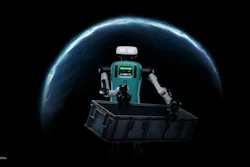
To build a genuinely smart warehouse, organizations must rethink their architecture. Modern warehouse performance relies on three distinct pillars: Automation (the muscle), human agility (the flexibility), and orchestration (the brain).
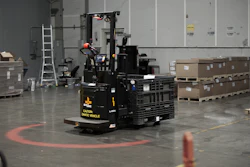
● Automation (the muscle): Provides the brute force needed for high-volume operations. Whether it is a high-speed sorter or a fleet of AGVs, these systems excel at repetitive, high-speed tasks. However, they are inherently rigid. They cannot easily pivot when an unexpected carrier delay occurs or when a SKU's dimensions change.
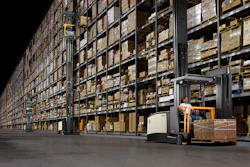
● Human agility (the flexibility): Represents the cognitive flexibility and fine-motor dexterity that machines still lack. Humans can troubleshoot issues, manage exceptions, and navigate complex physical environments with ease. Yet, humans are also the most variable resource, and managing their productivity in a silo leads to inefficiencies.
● Orchestration (the brain): Without orchestration acting as the real-time brain to synchronize them, the muscle and the flexibility operate in silos, creating "islands of automation." Without this coordination, a super-fast robot might simply dump inventory onto a pile that entirely overwhelms human packers. Orchestration ensures that every part of the facility is working in concert toward the same goal: maximizing throughput while minimizing costs.
The hidden cost of decision latency
The failure to orchestrate these pillars results in decision latency, the critical time gap between a disruption occurring and a corrective action being taken. In a high-velocity fulfillment center, thirty minutes of "head-scratching" by a floor supervisor equates to thousands of dollars in lost throughput. This latency often manifests as "automation starvation," where a $10 million AS/RS system sits idle because an upstream manual replenishment task was delayed by a minor bottleneck that went unnoticed until it was too late.
Furthermore, decision latency breeds a culture of chronic over-scheduling. To hedge against the unpredictability caused by poor orchestration, managers often over-staff shifts by 10–15%. This "just-in-case" labor model not only erodes margins but also contributes to the industry’s high turnover rates. When workers are poorly utilized or constantly shifted between tasks without a clear plan, morale drops. A truly smart warehouse uses intelligence to eliminate this "slack," creating a more stable, predictable environment for the workforce.
Breaking silos with agentic AI orchestration
The next evolution of the smart warehouse replaces static task management with an agentic AI supply chain. Instead of a highly disruptive "rip and replace" of core infrastructure, intelligent decision agents sit on top of the existing WMS, LMS, and ERP systems, serving as a centralized, real-time decision layer. This 'layer' approach allows companies to modernize their logic without risking the stability of their core transactional systems.
These intelligent agents operate using a continuous sense-decide-act-learn control loop. They communicate using structured natural language, allowing a network of specialized agents, such as a warehouse agent, transport agent, and control tower to negotiate tradeoffs autonomously at machine speed.
For example, if a high-speed sorter is about to starve because an upstream forklift operator is occupied with a low-priority task, the decision agent instantly calculates the financial cost of that performance loss. It then autonomously triggers a priority override in the WMS, rerouting the operator before the starvation occurs. This agentic behavior creates a self-healing supply chain in which disruptions are identified and mitigated before they affect the bottom line.
Conversational interfacing and the human factor
A truly smart warehouse fundamentally changes how human leaders interact with the building's data. Through voice-activated interfacing, supervisors are no longer tethered to dashboards in a glass-walled office; they can walk the floor and speak directly to the facility's AI using a mobile device or headset. This mobility allows leaders to spend more time coaching their teams and less time analyzing spreadsheets.
A manager can ask the agent in natural language: "What is the impact on our 4:00 PM outbound window if we move three pickers to receiving right now?" The system instantly analyzes millions of execution variables to provide a data-backed recommendation.
Furthermore, the agent features "Explainable AI." In the past, optimization algorithms were "black boxes" that workers often distrusted or ignored. Today, if an agent reprioritizes a task, a worker can ask why. The AI might explain that a specific shipment was moved up because a carrier arrived early, or a specific SKU is trending toward a stock-out. This transparency transforms AI from a dictatorial supervisor into a collaborative daily copilot, bridging the trust gap and ensuring that technology supports, rather than replaces, human expertise.
From connected to autonomous
The competitive advantage of the next decade will not belong to the warehouses with the fastest physical robots, but to the best-orchestrated facilities. Automation without intelligent synchronization merely accelerates chaos. By embracing Agentic AI and warehouse orchestration, supply chain leaders can transform their facilities from reactive environments into autonomous, highly reliable engines of productivity.
As warehouses continue to evolve, the distinction between "smart" and "connected" will become even clearer. A connected warehouse has the data; a smart warehouse has the agency to use it. Orchestration is the final bridge, connecting high-tech machinery with high-performing human teams to finally end the era of being data-rich but insight-poor.