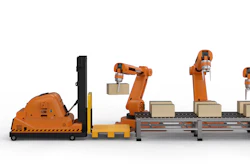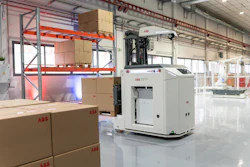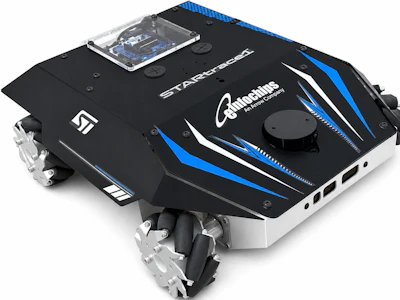
Arrow Electronics and its subsidiary eInfochips partnered with STMicroelectronics (ST) to unveil a new industrial autonomous mobile robot (AMR) reference platform, designed to shorten the path from concept to deployment for professional service robots.
"This solution brings together the performance, flexibility, and pre-validated integration robotics customers need to move faster from development to deployment, while giving them a scalable foundation that can address a broad range of industrial and commercial robotics applications," says Shelby Schnurrenberger, VP, supplier management, global semiconductor, Arrow Electronics.
"ST's broad industrial portfolio is a natural fit for autonomous mobile robot applications, where reliability, performance, and scalability are essential. By combining our technologies with Arrow's engineering services, we are helping customers turn innovative robotic concepts into industrial-ready solutions. Together, we can accelerate the development of the next generation of AMRs for the market," adds Allan Lagasca, application director - robotics segment strategic program (SSP), smart industrials segment leader, STMicroelectronics.
Key takeaways:
· This fully functional AMR kit is built on a complete ST bill of materials, tightly integrated with an NVIDIA Jetson Orin Nano-based compute platform and NVIDIA ROS 2 software stack.
· Arrow and eInfochips contribute their Rover mechanical platform and system integration expertise, while ST provides a comprehensive portfolio of industrial-grade components and reference designs.
· The new AMR reference kit combines robust power and battery management for 24V operation, with a pre-validated path to 48V architectures; STM32-based real-time controller board, acting as a powerful interface between the NVIDIA platform and the robot's sensors and actuators; advanced motion control, including dual BLDC motor drives based on STSPIN32 and STDRIVE devices for precise, smooth navigation; rich sensing for perception and safety, using ST MEMS IMUs, magnetometers, and environmental sensors, complemented by lidar and vision inputs for SLAM-based mapping and navigation; and industrial ROS 2 software integration, enabling mapping, localization, and autonomous navigation with standard tools such as Cartographer, NAV2, and RViz ROS 2.