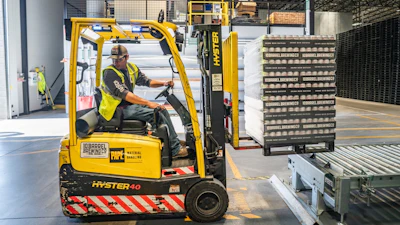
Whether planning new warehouse construction, an expansion, or simply beefing up your current operations, there’s no getting around the many challenges inherent in powering a fleet of manual forklifts, autonomous guided vehicles (AGVs), autonomous mobile robots (AMRs), or a mix.
The key is to avoid vehicle downtime due to charging requirements. And that’s why warehouse managers need to treat vehicle charging as infrastructure.
The goal is simple: Move power from the grid or other energy source to your vehicles’ batteries. Here the challenges include getting enough power and having enough chargers with the right capacity and capabilities to make everything work together for the current (and future potential) fleet. Of course, these factors vary widely from warehouse to warehouse.
Every system has a throughput limitation or bottleneck at one stage or another. Some are easier to fix than others. Adding an additional vehicle is a straightforward capital investment unless you didn’t plan for charger expansion.
Battery chargers are hardest and costliest to install after a fleet has become operational because they often have several airflow and mounting requirements, require an electrician to install extra infrastructure, and are burdened with other limiting factors. Battery or forklift capacity issues can be fixed more easily later.
Clearly, warehouse managers should provision for future battery chargers as early as possible in new warehouse construction. The question then becomes, how do you determine how many chargers of what kind are needed, and where do you put them?
Crunching the numbers to support demand
Warehouses typically generate a power study to accurately determine the required number of batteries and chargers. The problem is that power studies require data from existing vehicles, which is no help when contemplating new construction. A newly constructed warehouse must forecast its needs using historical data and estimates.
A warehouse capable of charging 10 vehicles may be able to scale to 12 or even 15 vehicles without significant workflow disruption. This is especially true if the vehicles use opportunity charging.
However, that warehouse will almost certainly need to expand its charging infrastructure to charge, say 20 vehicles. Adding additional vehicles to an already congested charging network will create downtime as vehicles are tied up charging or, worse, waiting to charge or jockeying for position among the remaining available chargers.
Select the battery mix that fits your operation
When designing a warehouse, it is important to consider wired versus wireless charging. Both are valid solutions depending on the warehouse requirements. Battery chemistry—lead-acid vs. lithium-ion—also comes into play here.
Wired charging is a simple, mature, and popular technology offering a low installation cost and high electrical efficiency. However, wired chargers commonly fail as mechanical contacts wear out, dirt builds up, etc. Wired chargers offer many charging strategies, including the possibility for opportunity charging. Wired charging pairs well with battery swaps and can work in any shift schedule.
Wireless charging is an up-and-coming alternative. It is often more expensive to install but does not suffer from mechanical contact wear or dirt buildup. Wireless charging works better in harsh environments and is especially attractive for automation customers who want to use opportunity charging. When used with manned applications, it also adds convenience: no need to get out of a vehicle to plug in the charger. Its relatively poor power efficiency has been a drawback, but new wireless chargers are rapidly approaching an efficiency similar to wired chargers. Wireless charging pairs well any shift schedule.
Lithium-ion batteries can be a game changer for an opportunity charging strategy. Even a small amount of charging time can extend lithium-ion battery life. If vehicles use opportunity charging a lot, wireless charging allows for the use of smaller, lighter, and less expensive vehicle batteries, significantly reducing capital expense. This also means fewer or no battery swaps, which also reduces total cost of ownership.
For a one-shift warehouse using lead-acid batteries, it’s normal to plan one charger for each vehicle. But for a one-shift warehouse using lithium-ion batteries, you may be able to plan for fewer than one charger per vehicle if there’s sufficient time for opportunity charging.
Of course, you also have to consider the chargers’ power capacity. An undersized charger may not effectively charge batteries in the given time. Fast chargers provide more effective use of opportunity charging, um, opportunities such as during lunch or other breaks.
Make a mixed-fleet charging strategy that works
Running AGVs, AMRs, and manned forklifts under the same roof, often across different manufacturers and battery chemistries, exposes every assumption a charging strategy was built on. You can't apply a single charging policy uniformly across these large, mixed fleets.
Mixed chemistries create mixed failure modes. Lead-acid batteries periodically need equalization cycles, which pull vehicles out of rotation for hours. Lithium-ion packs don't need that, but they're more sensitive to thermal conditions and charge rate consistency.
Operators quickly learn the difference between redundancy and resilience. Spare chargers help with demand spikes, but it’s just as important to distribute loads deliberately and proactively monitor charger health.
At scale, none of this is manageable without visibility. The fleets hitting 24/7 uptime targets are using fleet software not just to dispatch vehicles, but to catch charging anomalies before they become downtime events.
Conclusion: Plan ahead and build in flexibility
As warehouse automation matures, the best-performing fleets will run on a charging infrastructure designed to grow with them, not retrofitted around them. Going from a single shift with a handful of forklifts to dozens of mixed AGVs and AMRs running 24/7 is a stress test for every charging decision made at the outset.
The tools are there: wireless charging is closing the efficiency gap, lithium-ion and opportunity charging are reshaping battery economics, and fleet management software is giving operators the visibility they need to stay ahead of downtime. But none of that matters if you still treat charging as an equipment purchase rather than a strategic infrastructure decision.