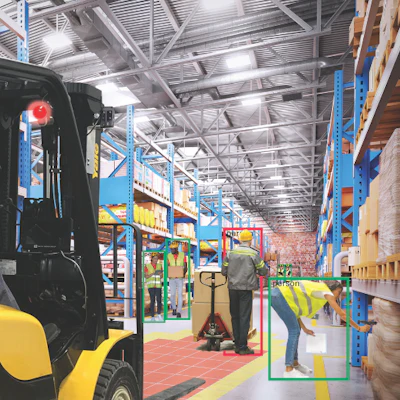
Smart warehousing has become a critical theme in industrial operations. Leaders are focused on faster fulfillment, tighter inventory control and better visibility across assets and labor. That pace supports national goals tied to domestic manufacturing and supply chain resilience, but it also creates a more demanding safety environment on the floor. As facilities move faster, AI-powered collision avoidance systems are being evaluated to help detect hazards in real time, support operator response and reduce risk without slowing the operation.
The urgency is real. Forklifts were the source of 84 work-related deaths in 2024 and 25,110 DART cases in 2023-2024, according to the National Safety Council. Pedestrian incidents involving motorized land vehicles also increased 19% in 2024, according to the U.S. Bureau of Labor Statistics.
Warehouses and manufacturing facilities are shared spaces. People walk, pick, stage, load, inspect and maintain. Mobile equipment moves continuously. Forklifts, tuggers, reach trucks, pallet jacks and yard tractors follow routes that change by shift, demand and available space. Congestion often builds near docks, cross aisles, battery charging areas and high-turnover pick zones. Every increase in movement creates more interaction points. Every interaction carries collision potential.
Many organizations already invest in safety fundamentals. Training helps. Signage helps. Marked pedestrian lanes, mirrors, speed limits and operator procedures all have value. Incidents still occur because risk is often driven by conditions these measures cannot fully remove. Blind spots, blocked sightlines from racking, tall loads, tight turning radii and limited reaction time can challenge even experienced workers.
Where risk concentrates in modern facilities
Collision exposure often clusters in predictable places and moments.
Aisle intersections create uncertainty. An operator may approach a cross aisle with limited sightlines as a pedestrian exits into the same crossing. Mirrors can help in some layouts, but glare, dust, viewing angles and congestion can reduce their value.
Dock areas compress time. Trailer arrivals can trigger a surge of movement as pedestrians, pallet loads and vehicles converge. Noise increases. Lines of sight shrink. Decisions happen quickly.
Carrying a load can significantly reduce visibility, especially when tall pallets obstruct the operator’s forward view. While operators may adjust by driving in reverse or shifting position, those workarounds become less effective in busy or changing traffic environments.
Mixed traffic adds complexity. Pedestrians, forklifts and other mobile equipment often operate in the same environment. Different vehicle types have different stopping distances, turning behaviors and blind spots. A pedestrian stepping from behind racking or near a trailer can be difficult to see until the risk is immediate.
Engineered visibility as a practical control
Administrative controls influence behavior. Engineering controls change the system. In high-velocity facilities, engineering controls carry special value because they reduce reliance on perfect human perception.
Visibility is central to many vehicle-pedestrian events. A worker cannot respond to something they do not perceive. A forklift operator cannot avoid a pedestrian who is fully hidden until the last moment. Engineered visibility can include layout separation, controlled crossings and sensing systems that identify hazards in blind spots.
The next step is making detection actionable. Audio alarms can help draw attention, but alarms alone are not enough in loud, fast-moving facilities. Workers may miss them, tune them out or have too little time to react. Systems that combine real-time detection, clear operator alerts and forklift integration can provide a stronger layer of protection.
How AI fits the safety goal
AI has entered warehouses in many forms. Safety use cases require a practical standard: reliable detection, clear communication and measurable risk reduction.
In collision prevention, AI-powered vision can help detect personnel and vehicles near a forklift, including in blind spots, cross aisles, dock areas and tight corners. When paired with radar, edge processing and configurable detection zones, these systems can identify risks in real time and deliver audible and visual alerts to the operator. Optional in-cab displays can further support awareness by giving operators clearer information in the moment.
The key is going beyond awareness alone. A collision avoidance system that supports forklift integration can provide an additional layer of intervention, including automatic slowdown depending on configuration. That matters because slowdown can give the operator more time to respond and reduce reliance on a perfect human reaction during a high-pressure moment.
Detection also needs to fit the facility. Zones should be configurable for the actual work environment, from cross-aisle intersections to trailer loading areas. Customizable detection zones allow teams to focus on the areas where interaction risk is highest. They also help reduce nuisance alerts that can cause workers to tune alarms out.
Hardware matters as well. Forklift safety technology operates in harsh conditions with vibration, dust, temperature changes and impact risk. Rugged cameras, hubs, alerting devices and in-cab monitors need to be built for industrial environments. Durable, protected components help support reliable performance in demanding applications.
Data and continuous improvement
Collision avoidance should not be treated as a one-time installation. It should feed a broader safety improvement process.
Event data can help teams understand where risk is actually occurring. Time-stamped photos, zone breach reporting, device status and dashboards can point safety leaders to high-risk locations, recurring traffic conflicts and areas where training or layout changes may be needed.
That data can help facilities move from reacting to incidents toward identifying patterns earlier. If repeated zone breaches occur at a cross aisle, the answer may include traffic redesign, improved separation, adjusted detection zones or additional coaching. If nuisance alerts rise in a specific area, the system may need tuning. The value comes from combining technology with active safety management.
A practical evaluation checklist
· A review should resemble safety control validation.
· Define the risk domain. Map the interaction points with the highest exposure using incident history, near-miss reports and supervisor observations.
· Clarify performance limits. Consider occlusion, glare, dust, vibration, lens obstruction and seasonal lighting. Confirm maintenance needs.
· Measure alert quality and timing. Late alerts do not help. Excess alerts become noise. Test systems at real travel speeds and in actual traffic patterns.
· Evaluate intervention. Determine whether the system can integrate with forklifts and support automatic slowdown where appropriate.
· Check usability. Alerts must be understandable in the moment and tied to a clear response, such as slow, stop or yield.
· Plan for site tuning. Dock zones differ from aisle travel. High-pedestrian areas need different sensitivity than long travel lanes.
· Define outcomes. Track near-miss trends by zone, speed compliance at crossings, collision events, damage incidents and downtime.
· Build maintenance into standard work. Inspection, cleaning and verification should be routine.
Why this matters now
A renewed focus on domestic production raises expectations for the industrial backbone. Warehouses sit at the center of that backbone. A facility that cannot operate safely at speed becomes a bottleneck. A facility that maintains safe flow under pressure becomes a resilience asset.
U.S.-built industrial technology can shorten feedback loops from field performance to engineering improvement. It can also support more predictable service response and parts availability. Those factors influence uptime and safety readiness in practical ways.
Smart warehousing will continue to accelerate. The sustainable path pairs productivity gains with safety controls that scale. Collision prevention belongs near the top of that list because the consequence is high and the exposure is frequent. Facilities that prioritize engineered visibility, real-time detection and integrated intervention will be better positioned to protect workers and sustain performance under real production pressure.