The FCC added foreign-produced mobile robots to its Covered List in July 2025, requiring new models to obtain Conditional Approval before import or sale in the United States. Existing authorized robots can continue operating and receiving updates through at least January 2029, but the ruling primarily targets Chinese-manufactured robots and components, creating compliance challenges for international vendors while pushing Chinese manufacturers toward supply chain localization.
- FCC Covered List Addition: On July 28, 2025, the FCC added foreign-produced advanced robotic devices to its Covered List, preventing new foreign-made models from receiving equipment authorization without Conditional Approval.
- Definition Scope: Advanced robotic devices are mobile, ground-based systems weighing over 4.4 pounds with sensors, network connectivity (200+ kbps), and autonomous navigation software—including logistics AMRs, AGVs, quadrupeds, and humanoids, but excluding fixed industrial arms.
- Existing Fleet Protection: Robots already authorized and deployed in the U.S. can continue operating and receiving firmware/security updates until at least January 1, 2029, providing near-term stability.
- Unresolved Ambiguities: Key questions remain unanswered: what constitutes a "new model," the Conditional Approval timeline and criteria, how "foreign-produced" applies to assembled components, and where mobile robots end and fixed automation begins.
- Market Impact: Chinese vendors are expected to accelerate supply chain localization and component sourcing changes, while U.S. operators will prioritize FCC authorization status and regulatory resilience in vendor selection.
In recent years, the mobile robot market has expanded rapidly, moving from a nascent and fragmented sector into a more mature market characterized by larger-scale deployments. Annual shipments increased from around 30,000 units in 2018 to more than 200,000 in 2025, equivalent to a compound annual growth rate of approximately 32%. By 2030, we forecast that annual shipments will rise to just under 500,000 units.
China remains the largest market for mobile robots. However, rising supplier competition and weaker post-pandemic growth conditions have compressed margins, prompting many Chinese mobile robot manufacturers to look overseas for growth. In 2018, Chinese mobile robot manufacturers shipped 91% of their units domestically; by 2025, this fell to 64%. As Chinese vendors have expanded internationally, their share of mobile robots deployed in the United States has increased significantly, rising from 1% in 2018 to 36% in 2025.
At the same time, the current U.S. administration is using trade and security policy to strengthen domestic manufacturing and reduce reliance on foreign technology suppliers. The clearest precedent is the FCC’s December 2025 decision to add foreign-produced uncrewed aircraft systems and critical drone components to its Covered List, preventing new foreign-made drone models from receiving the equipment authorization required for import, marketing, or sale in the United States. Existing authorized drones were not grounded, but the action created a forward-looking barrier for new models.
FCC’s recent additions to the Covered List
On July 28, the Federal Communications Commission (FCC) added two further categories to its Covered List: foreign-produced advanced robotic devices and foreign-produced connected power inverters. The Covered List is the FCC’s register of equipment and services deemed to pose an unacceptable risk to U.S. national security or the safety and security of U.S. persons. Once a product category is added, new covered models are generally unable to receive FCC equipment authorization unless they secure a Conditional Approval.
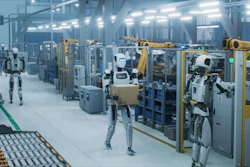
An advanced robotic device is defined as a mobile, ground-based device that can operate away from a human operator, weighs more than 4.4 pounds, including any dock or ground station, and combines sensors, network connectivity of at least 200 kbps and software that controls navigation, perception, data collection, or remote command. The FCC explicitly names quadrupeds, humanoids, and wheeled or tracked ground vehicles as examples.
Fixed industrial robot arms are explicitly carved out. The determination excludes fixed, stationary, non-mobile robots, including articulating, parallel/delta, Cartesian/gantry, and SCARA robots intended for industrial or medical use. It also excludes connected vehicles, rail vehicles, drones, unmanned underwater vehicles, and FDA-regulated medical and mobility devices.
Mobile robots used in logistics — including AMRs and AGVs for goods-to-person, sortation, and picking applications — appear to sit squarely within the scope. The determination even references the use case directly, noting that advanced robotic devices have applications in industrial manufacturing, from material handling to order fulfilment.
Written for everyone, built around one country
Read literally, the rule is country-neutral. It applies to devices “produced in a foreign country” and states that this applies “regardless of the nationality of origin” of the producer. In other words, a robot manufactured in Germany or Japan is, on paper, subject to the same restriction as one manufactured in China.
In practice, however, the evidentiary basis for the determination is drawn largely from Chinese examples: security vulnerabilities linked to Unitree quadrupeds, a reported backdoor attributed to a Chinese manufacturer, and broader commentary on Chinese dominance of the humanoid robot supply chain. This policy is perceived to be designed to survive scrutiny as country-neutral while functionally targeting the dependency that most concerns Washington: the concentration of robotics manufacturing, and critical components such as actuators, batteries, and sensors, in China.
For allied-country vendors in Japan, South Korea, and the EU, the compliance burden exists on paper. However, the enforcement focus and political attention are likely to fall most heavily on Chinese-built fleets and Chinese-headquartered vendors.
What this means for vendors and operators
Whilst initial reporting focused on humanoids and quadrupeds, it’s since become clear this is far more expansive in its scope. A number of mobile robot manufacturers and system integrators are taking this very seriously, with most describing the situation as being highly dynamic.
The good news is that for fleets already deployed in the United States, the immediate risk appears low. Existing authorized models can continue to be sold and used, and the FCC has also allowed authorized devices to continue receiving certain software and firmware updates, including security and compatibility updates, until at least Jan. 1, 2029. This presents a significant benefit to international vendors who have already expanded into the United States.
However, even for those that are well established in the United States, there will likely be disruptions further out: with next-generation hardware, material firmware or hardware changes that require re-authorization, or new SKUs from Chinese-headquartered mobile robot vendors with a meaningful footprint in the U.S. market. For those vendors, Conditional Approval becomes a strategic dependency rather than a regulatory formality.
What we do not know
Several important questions remain unresolved:
- What counts as a “new model” remains undefined. The FCC documents do not clearly specify the threshold at which a product becomes a new model. It is unclear whether this would include a firmware revision, a hardware refresh, a rebrand of an existing platform, or only a materially new product. This is the single biggest practical ambiguity for vendors because it determines whether existing authorized product lines can continue evolving without triggering the new-authorization block.
- The Conditional Approval process has no published timeline or criteria. Applications for robotic devices go to the Department of War, but there is no stated review period, no published standard for what “does not pose unacceptable risk” means in practice, and no precedent yet of an approval being granted for this category.
- How “foreign-produced” will be tested at the margins is not settled. The determination relies on the “domestic end product” definition in 48 CFR § 25.101(a), a technical procurement-law test built around U.S. content thresholds. It is not yet clear how strictly this will be applied to a robot assembled in Vietnam or Mexico from a majority-Chinese component set, precisely the kind of ambiguity that has shaped recent drone-sector responses, including Malaysia assembly and rebranding strategies.
- Litigation risk and industry pushback remain unclear. Following the December 2025 drone action, DJI and industry groups responded quickly. A similar response from robotics vendors, integrators, or trade associations would not be surprising, but there has not yet been enough public evidence to judge the likely scale or direction of pushback.
- Where mobile robots end and fixed automation begins. It’s still not clear where a mobile robot form factor and fixed automation solution begins. As an example, does a mobile AS/RS system or a pallet shuttle count as a mobile robot or a fixed solution?
What to expect next
This announcement may result in a short-term market disruption, as end customers pause investment while they wait for the dust to settle and for key questions to be answered. This would help them avoid committing to technologies that may ultimately not receive FCC approval. System integrators and automation vendors have emphasized that this is a dynamic situation, with developments moving very quickly. One system integrator is urgently contacting all international mobile robot suppliers to discuss the implications. Operators should expect existing authorized models to remain available, while new models from foreign-produced mobile robot vendors face a more complex path to market.
Chinese-headquartered vendors are likely to respond by accelerating supply chain localization, shifting final assembly outside China, increasing the share of non-Chinese components, and preparing Conditional Approval applications for priority models. However, until the FCC and national security agencies clarify how they will treat component origin, final assembly, and model changes, localization strategies will remain difficult to validate.
U.S. operators and integrators should expect procurement conversations to shift from price, performance, and service coverage toward regulatory resilience. Questions around FCC authorization status, firmware update pathways, component sourcing, and contingency supply will become more important in vendor due diligence, particularly for deployments with long asset lives or critical operational roles.