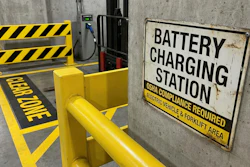
Managing energy cost volatility can contribute to warehousing success as much as implementing automation or systems that optimize inventory visibility. For forklift fleet managers, this opportunity isn’t limited to buying the right electric lift trucks and choosing the right type of battery. It also requires an understanding of when power is used, how much is needed and how much your fleet consumes.
Although it may be easy to focus on forklifts or batteries alone, your energy cost and return on investment (ROI) depend on understanding the entire forklift power ecosystem. To gain full visibility, consider multiple variables such as your application and its usage patterns, forklift batteries, chargers and charging practices, your power infrastructure and the available power from the grid.
Balancing battery efficiency
Your battery type affects how efficiently energy is stored and delivered. Lead-acid batteries, for example, can lose significant energy as waste heat.
Lithium-ion batteries can increase grid draw due to faster charging cycles, but consume about 16% less energy overall. Centralized battery rooms, spare batteries, long-term charge cycles and eight-hour cool-down periods associated with lead-acid batteries are unnecessary. Lithium-ion batteries support opportunity charging, which can reduce the need for spare batteries. Some lithium-ion systems can also provide operational advantages by enabling batteries, chargers, and lift trucks to communicate vital information.
The ROI case for switching from lead-acid to lithium-ion batteries may be stronger in high-throughput, multi-shift operations that require frequent battery swaps. Lead-acid technology remains viable when usage patterns and disciplined battery maintenance support it. In some operations, the right answer could be a mixed-power strategy involving multiple battery types, so it can be helpful to work with a supplier that offers both solutions.
Charger upgrades can offer energy savings
Operations teams can look at chargers first when evaluating their energy use. Charger efficiency has improved significantly in the past 15-20 years. Modern high-frequency chargers can reach up to 97% efficiency.
By contrast, older charging systems may waste as much as half the power drawn from the grid during the charge cycle. As a result, upgrading your charger technology can create meaningful savings, even if you’re not prepared to make other changes.
Check your utility bill
Every facility receives a power bill, but operations with similar power usage and charging behaviors can face very different costs on their local utility rate structures.
Check your utility bill and the rate structure of your local utility for peak-demand charges. It may be possible to adjust your charging schedules to avoid peak-demand periods without compromising operations.
Demand charges are often tied to these peak usage periods, which can be influenced by increased HVAC loads during summer and winter temperature extremes. Peak usage periods can vary by region, utility, season and time of day, so be sure to know your utility’s precise criteria.
Programmable charging can help avoid peak-demand charges
Immediate savings can usually be achieved by charging outside of peak-demand periods that apply to the facility. Although reducing or pausing charging during these times can yield savings, this strategy must be balanced against your operational requirements.
In multi-shift operations, the goal is not necessarily to prevent peak charging entirely, but to manage charging more intelligently. For example, in a region with a 4–9 p.m. peak usage period, a site running a second shift may limit the number of lift trucks that charge during that time frame.
Advanced demand response systems can help automate these decisions. These connected chargers can be grouped and programmed for spot pricing limits, target peak loads, limited infrastructure or other factors that could increase energy cost, so they proactively manage available power at specified times.
Understanding the total picture
Different facets of an operation may possess unique knowledge needed to make informed decisions. Utility bills reveal cost-per-kWh rates and peak-demand periods. Facilities teams understand available electrical capacity. Operators know when lift trucks are being plugged in outside recommended charging periods. Fleet and operations managers monitor fleet readiness for each shift.
This is why energy management shouldn’t be treated as just a back-office or floor-level exercise. It requires a feedback loop that shares cost data, infrastructure limits and actual fleet usage. This communication is often established as a power study is completed. As different parts of the organization feed information into the study, the need for ongoing data sharing becomes clear.
Charging strategies must be tested and evaluated in individual applications to ensure that energy is being used at the right time and in the right sequence, but with minimal disruption. Begin by implementing conservative parameters, then monitor whether lift trucks are available when operators need them. Adjust charging periods and limits over time based on operational feedback.
Avoid unnecessary infrastructure upgrades
One of the biggest potential benefits of smart energy management is the ability to delay or avoid infrastructure upgrades through more efficient energy use.
Older facilities may have wiring in certain areas that can’t support a full bank of chargers operating simultaneously. Instead of upgrading panels or service capacity, your facility may be able to proactively manage connected charger groups to defer or avoid costly electrical upgrades.
For example, consider a charging area that allows 20 lift trucks to be plugged in but is programmed to charge only 13 of them at a time. The system can prioritize charging based on the highest or lowest state of charge of each connected battery, depending on the organization’s operational goals.
Pay attention to charging activity
Another indicator of potential inefficiency is unexpected charging frequency. In the case of lithium-ion batteries, customers have shown that opportunity charging should be necessary only during standard breaks throughout the shift. If batteries need to be charged more frequently or for longer periods of time, there’s an opportunity to review charging data and utilization patterns.
Smart warehousing includes smarter energy decisions
Energy volatility is likely to remain a planning challenge. Forklift fleet owners can gain more control by viewing forklift power as a connected, data-informed system rather than an uncontrolled utility expense. Significant savings are possible when conducting a power study. Start with a clear understanding of every factor that affects your total energy cost: batteries, chargers, power usage, local utility rate structures and your operation’s shift requirements.