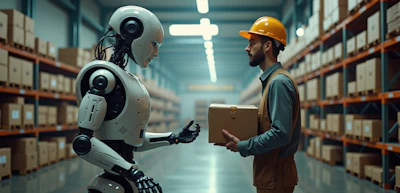
Smart warehousing has made enormous progress in automating movement. However, many of the most important warehouse tasks still resist full automation for one simple reason: robots can see, but they still struggle to feel.
That limitation matters more than many leaders realize. Warehouse leaders are under pressure to automate more operations, but many critical workflows still depend on human dexterity.
Consider a returned item arriving back at the warehouse. An associate can pick it up, feel that the packaging has softened, adjust grip to avoid further damage, and make an immediate judgment about whether it can be restocked, repacked, or routed for inspection. That kind of real-time physical judgment is difficult to automate, yet it is precisely the kind of capability that can improve warehouse performance.
This is where AI-enabled tactile systems are beginning to change the equation. Gartner predicts that by 2030, one-third of all medium and large warehouses will have at least one operational robotics platform. The next wave of value, however, will not come from simply adding more machines. It will come from making those machines better able to interact with the physical world.
Why touch is becoming a strategic capability
This technology combines high-resolution tactile sensing with AI-driven pattern recognition to help robots capture and interpret data that visual sensors often miss, including contact, force, texture, shape, and slippage. In practical terms, this gives robotic systems a far more nuanced understanding of how objects behave during physical interaction.
For smart warehouses, that is significant. Vision-only automation performs well when conditions are structured and predictable. But warehouse environments are rarely that neat. Inventory profiles change, packaging varies, products shift in totes and bins, and items differ in fragility, weight, and shape. These are precisely the kinds of conditions where human workers still outperform many automated systems because they can make constant micro-adjustments through touch.
This technology can extend automation into tasks that have traditionally remained manual, particularly in piece picking, packing, palletizing, returns processing, and other workflows where variability is high and precision matters.
In that sense, tactile AI is not just another warehouse technology upgrade. It represents a meaningful step toward physical AI: a continuous loop of perception, cognition, and actuation that enables machines to sense, decide, and respond in real time.
Why scaling will be a challenge
Gartner research shows that only 17% of supply chain organizations have succeeded in scaling AI pilots, while 77% of CEOs in supply-chain-centric organizations say current operating models will not support success in an AI-driven era.
AI-enabled tactile systems are powerful, but they also introduce significant technical and operational demands. Tactile sensors can drift over time and require careful calibration. Also, the data produced is continuous and computationally intensive, which can overwhelm conventional industrial architectures. Durability in particular remains a concern, especially in environments that require repeated physical contact.
To maximize the benefit of these systems, leaders must resist treating tactile AI as a standalone innovation experiment. Organizations will need to build the sensing, data, computing, and operating model foundation required for robots to act intelligently in real-world conditions.
What supply chain leaders should do now
To begin, focus on high-value tactile friction points — the tasks where vision-only automation has consistently fallen short and where better physical interaction would deliver immediate return. That may include fragile item handling, mixed-item picking, returns inspection, or high-variability packing operations.
From there, organizations should build for multimodal resilience rather than single-sensor performance. The most robust environments will combine tactile, force, and vision data in sensor fusion architectures that allow robotic systems to adapt to real-world variability.
Technical teams should also standardize on open middleware to improve interoperability and reduce future vendor lock-in. And because tactile data requires millisecond-level response, enterprises should prioritize edge computing that processes signals directly on the robot or at the cell level.
Most importantly, leaders should treat tactile AI as a strategic capability to evaluate over the next 3-6 years, not as a side pilot disconnected from broader warehouse transformation. The organizations that gain advantage will be those that start learning now, build cross-functional ownership early, and align technology choices with operating-model redesign.
The next phase of smart warehousing
For years, the industry has focused on helping machines move faster and see more. The next frontier is helping them sense better, respond faster, and handle variability with greater precision.
Tactile AI will not eliminate every warehouse challenge overnight. But they do point to a more important shift: from automation that follows instructions to automation that can adapt in the moment.
The future of smart warehousing will not be defined by AI alone. It will be defined by how intelligently AI can interact with the physical world.