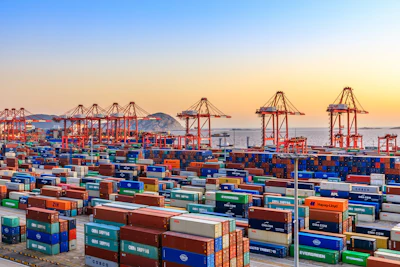
Shippers are entering the second half of 2026 with a cautious growth mindset. In fact, 71% expect freight demand to increase over the next six months, but most are not expecting easier conditions. What’s more, 92% say freight rates increased over the past year, 84% experience shipment delays at least monthly and 84% have changed shipment strategy frequently or occasionally because of disruption, according to Dimerco Express Group’s Asia-Pacific Freight Outlook for H2 2026 report.
"H2 2026 is likely to reward shippers that build optionality before they need it," the report notes. "Our role is to help you turn forecasts, route alternatives and multimodal choices into a practical freight plan, supported by clear service commitments, local execution and transparent decision-making."
Key takeaways:
· The survey points to an Asia-Pacific freight market where demand and risk are moving together. Geopolitical disruption ranked as the leading factor shaping shippers' outlook, selected by 33% of respondents, narrowly ahead of demand growth at 31%. Economic conditions followed at 20%.
· Asia-North America was the most frequently cited lane for both air and ocean users, selected by 57% of active air users and 61% of active ocean users. Asia-Europe ranked second.
· 84% of respondents report shipment delays at least monthly, and one quarter experience delays weekly or more often. Among shippers that adjusted strategy frequently or occasionally, 74% cited geopolitical disruption as a trigger, followed by port congestion at 49% and customs or regulatory delays at 40%.
· 69% of ocean users cite rate volatility as a current challenge, while 55% point to vessel schedule reliability, 51% to geopolitical disruption and 47% to port congestion. Half of valid ocean respondents say reliable capacity has declined over the past six months.
· Rate volatility is the leading air challenge at 56%, followed by schedule reliability at 47%, geopolitical disruption at 40%, capacity constraints at 33% and customs delays at 31%. Forty-three percent say reliable capacity improved over the past six months, while 41% say it declined.
· 84% of air users say ocean volatility has had a moderate or severe effect on air capacity or rates, confirming that emergency air capacity can become more expensive and harder to secure when ocean networks are unstable.
· Cost was selected as a Top 2 carrier selection factor by 65% of respondents. When schedule reliability and transit-time predictability are combined, they were selected by 69%.
· 42% of respondents changed their primary logistics provider in the past 12 months. Among those switchers, 70% cited pricing and 60% cited service reliability. No respondent identified pricing alone as the sole differentiator of a preferred logistics provider; pricing was always paired with at least one execution, visibility or expertise factor.