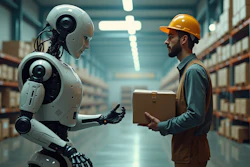
Picture a distribution center at 2 a.m. during peak season. Autonomous mobile robots are moving cases through the aisles. A vision-guided arm is depalletizing mixed SKUs at the inbound dock. Then a sensor trips a false positive, and the arm stops. Within seconds, three downstream robots queue behind it. A human associate, unsure whether to reset or escalate, waits. In 90 seconds, the bottleneck reaches the sorter. Throughput drops. Nobody made a bad decision. The operation simply had no playbook for this moment.
That scenario is becoming the defining challenge in logistics. The global warehouse automation market hit an estimated $33 billion in 2025 and is projected to approach $97 billion by 2035. Physical AI venture funding exceeded $7.5 billion in 2024 alone. The technology is arriving. What most operations lack is the leadership model to govern it.
The failure mode nobody budgets for
Most automation projects do not fail because the hardware breaks. They fail because the operating model around the hardware was never designed. A Logistics Viewpoints analysis of 2025 warehouse automation deployments found that integration not technology was the primary determinant of success or failure. Many warehouse management systems were never built to synchronize with real-time robotics orchestration or mixed-fleet environments. The result was congestion, duplicated tasks, and delayed exception handling.
In addition, McKinsey research puts the stakes in perspective: supply chain disruptions cost the average organization 45% of one year’s profits over the course of a decade, with month-long disruptions occurring every 3.7 years on average. When the disruption originates inside your own four walls - sparked by an autonomous system that no one knows how to govern - the cost is more than just financial; it is a fundamental erosion of organizational trust.
The World Economic Forum and BCG also observed in their 2025 Physical AI report that leading organizations are not merely adopting tools; they are redesigning how operations function end to end. That redesign is where the real leadership work begins.
System architect + coach: A leadership framework for blended operations
To close this governance gap, logistics leaders need to operate in two complementary roles simultaneously. The system architect plus coach framework provides that lens.
As system architect, the leader designs how autonomy operates. That means drawing workflow boundaries, which tasks run fully autonomous, which require human-in-the-loop oversight, and which stay manual. It means building escalation paths, so that when a robotic arm faults at 2 a.m., there is a defined handoff to a qualified human decision-maker within seconds, not minutes. It means assigning accountability so that every autonomous action has an owner. And it means specifying the telemetry to detect drift: the slow degradation in system performance that, left unmonitored, becomes a throughput disruption or a safety incident.
As coach, the leader builds the human capability the system depends on. Technology does not learn on its own. Operations learn when people are trained to interpret system behavior, intervene skillfully during exceptions, and feed improvements back in. That includes safety routines for shared workspaces, standard work for exception handling, and continuous-improvement cadences that keep the operation adapting as conditions change.
Neither role works alone. A perfectly architected system staffed by untrained people generates avoidable incidents. A highly skilled workforce operating in a poorly designed system exhausts itself compensating for structural gaps. The competitive advantage belongs to leaders who do both.
The shift to exception economics
Traditional logistics leadership centers on headcount, shift schedules, and units per hour. Physical AI shifts the unit of management from labor hours to workflow performance and specifically to the economics of exceptions. How frequently do autonomous systems escalate? How long does recovery take? What does each exception cost in throughput, quality, and safety?
Consider the productivity math. As autonomous systems absorb more routine tasks, the human role will increasingly concentrate in the areas machines cannot yet own: real-time judgment, exception recovery, and decisions that require context no sensor can fully capture. These will be the highest-leverage moments in the operation. Leaders who reach that future without the telemetry to track exception rates, recovery times, and escalation patterns will be flying blind through the most critical part of their workflow.
Getting there will require operating capabilities most logistics teams do not yet have: dedicated autonomy owners for each automated workflow, escalation playbooks that define who intervenes before the exception happens, accountability models that extend to what machines do on behalf of operations, and continuous-tuning disciplines that feed operational data back into robot parameters every shift.
Building a bilingual workforce
The workforce question is not whether to hire operations people or technology people. It is about building teams fluent in both—what might be called bilingual capability: associates who understand physical flow, safety, and quality, and who also understand how autonomous systems behave, fail, and improve.
This is already happening at scale. New roles are emerging industry-wide: robot leads coordinating human and autonomous workflows, automation technicians calibrating systems on the floor, and exception commanders owning real-time triage during live operations. These are not IT roles that relocated to the warehouse instead they are operations roles augmented with systems thinking fluency.
2 metrics that change leadership behavior
Traditional metrics remain necessary, but two additional measures are essential for governing a blended workforce.
Time-to-recover measures how quickly the operation restores normal throughput after an autonomous system exception. It forces leaders to invest in escalation design and associate training not just anchor on uptime. An operation that recovers from an exception in 45 seconds is fundamentally different from one that takes 12 minutes, even if both report identical units-per-hour at the end of the shift.
Time-to-proficiency tracks how quickly new team members become effective in roles requiring both operations knowledge and systems fluency. As bilingual roles become the norm, this metric exposes whether workforce development is keeping pace with the technology being deployed. A shrinking time-to-proficiency signals a mature coaching system. A growing one signals a leadership gap.
The leadership imperative
The competitive gap in logistics will not be determined by who purchases the most automation. It will be determined by who designs the operating model that allows autonomy to scale, with clear decision rights, safety guardrails, skilled people, and the telemetry to learn and improve continuously.
Physical AI does not replace decades of expertise in people, product, and process; it amplifies it. The leaders of the next chapter will be system architects and coaches, designing bounded autonomy while building the human capability to govern it. By finally closing the execution gap, they will move beyond mere visibility to the ultimate competitive advantage: the velocity of action.
Logistics leaders have spent decades mastering the choreography of people, product, and process. Physical AI does not erase that expertise. It extends it into a new domain. The leaders who define the next chapter will be those who step into the dual role of system architect and coach, designing how autonomy operates and building the human capability to make it better every day.