
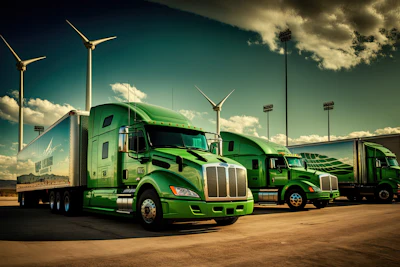
A prolonged freight recession now in its third consecutive year has been compounded by sweeping federal policy reversals, tariff-driven cost increases of up to $35,000 per new truck, and geopolitical volatility affecting global supply chains and energy markets, according to the State of Sustainable Fleets 2026 Market Brief authored by authored by TRC Companies, a WSP member company.
The rollback of federal greenhouse gas (GHG) vehicle standards, the expiration of zero-emission vehicle (ZEV) tax credits worth up to $40,000 per eligible medium- and heavy-duty (MD/HD) vehicle, the cancellation of federal clean transportation funding, and the nullification of California’s clean truck regulations have restructured the policy landscape from a federally driven system to a decentralized patchwork of state policies and market-driven factors.
"In a very short time we’ve moved from ‘what’s the best AI-enabled drivetrain’ to ‘how do I utilize each where it works best’ to manage cost and uncertainty. Adoption of multiple advanced, clean technologies for medium- and heavy-duty fleets has emerged as the defining strategy instead of the retreat that many had predicted,” says Nate Springer, VP, market development, TRC Companies.
Key takeaways:
· More than $5 billion in state, local, and utility program funding remains available annually through 2028 supporting clean fleet investment. And, fleets managing total cost of ownership (TCO) across a portfolio of powertrain technologies — rather than concentrating on a single solution or waiting out the uncertainty — are demonstrating measurably greater resilience.
· AI-powered fleet management has moved from experimentation to mainstream operations. Approximately half of fleets report using AI for route optimization, dispatching, predictive maintenance, and maintenance diagnostics — with users reporting measurable cost savings, greater vehicle uptime, and improved fleet utilization.
● Survey respondents project that 35% of their fleets will be AI-enabled by 2027, nearly doubling from an estimated 20% across the fleet in 2025. Among respondents, 49% reported that none of their fleet had been AI-enabled as of 2025, signaling a significant near-term adoption runway.
● Driverless light-duty vehicles have logged millions of miles, and HD autonomous trucks entered commercial freight service in 2025. Broader heavy-duty rollouts across more routes and regions are expected by end of 2026.
● Zero-emission tax credits of up to $40,000 for eligible MD/HD vehicles expired; DOE’s Vehicle Technologies Office budget was cut approximately 90%; $2.2 billion in hydrogen R&D funding was rescinded, including so-called “Hydrogen Hubs”; and the DOT’s National Electric Vehicle Infrastructure (NEVI) program was suspended for six months.
● Despite federal cuts, available funding for clean fleet projects remains well above pre-2022 levels: more than $5 billion in state, local, and utility programs is estimated annually through 2028.
● The EPA finalized record-high Renewable Fuel Standard (RFS) volume obligations for 2026 and 2027, requiring approximately a 60% increase in biodiesel and renewable diesel production and use compared to 2025 levels.
● New Class 8 tractor registrations declined 16% in 2025 according to S&P Global Mobility data amid the prolonged freight recession, tariff-driven cost increases, and economic uncertainty. More than one-third of survey respondents reported using efficiency technologies, with leading heavy-duty adopters in the logistics sector achieving 8.5-plus mpg and best-in-class operations demonstrating 11.5 mpg or higher.
● Renewable diesel (RD) and biodiesel (BD) are displacing conventional diesel at scale: the two fuels combined to replace 74% of conventional diesel used in California transportation in 2024 and 71% in the first three quarters of 2025.
● The EPA’s Clean Trucks Plan establishing MY 2027 NOx and particulate matter (PM) standards for MD/HD vehicles remains on track, with incremental per-vehicle costs expected to range from $8,000-18,000. Final warranty and useful-life provisions are still pending.
● Renewable natural gas (RNG) accounted for 97% of all natural gas fuel used in California transportation in 2025. Among NGV-using fleets in the survey, 65% report RNG use, which they estimate accounts for 78% of their total fueling volume.
● 32% of propane-using fleets reported using it in 2025, up from just 10% in 2023.
● MD/HD BEV registrations increased in 2025, led by pickup trucks and delivery vans that set a new record in the MD segment. Fleets operating MD BEVs and HD yard electric tractors reported total cost of ownership benefits compared to the vehicles they replaced.
● Global market signals point to long-term BEV competitiveness in heavy-duty applications: BEVs now represent 22% of China’s HD truck market, and battery costs in that market have fallen to $90/kWh.
● Near-term U.S. growth faces headwinds from the expiration of EV tax credits and manufacturer production pivots. However, data from a California funding program and other signals show that Class 8 truck deployments should exceed the 1,000 annual deployments mark for the first time.
● Hydrogen fuel cell electric vehicle registrations dropped 12%, the cancellation of much of the Hydrogen Hub funding removed a critical development resource, and two prominent Class 8 FCEV manufacturers exited the market.
● Long-term hydrogen sector viability for heavy-duty transportation is expected to depend on sustained federal investment in research, development, and fueling infrastructure that private capital alone will not provide at scale. Coordinated government investment remains the defining variable for hydrogen’s commercial future in freight.
![Top Tech Logo 2026 Vertical [color]](https://img.sdcexec.com/mindful/acbm/workspaces/default/uploads/2026/04/top-tech-logo-2026-vertical-color.mWl7RAiZmg.png?auto=format%2Ccompress&bg=fff&fill-color=fff&fit=fill&h=100&q=70&w=100)







![Top Tech Logo 2026 Vertical [color]](https://img.sdcexec.com/mindful/acbm/workspaces/default/uploads/2026/04/top-tech-logo-2026-vertical-color.mWl7RAiZmg.png?ar=16%3A9&auto=format%2Ccompress&bg=fff&dpr=2&fill-color=fff&fit=fill&h=135&q=70&w=240)


