
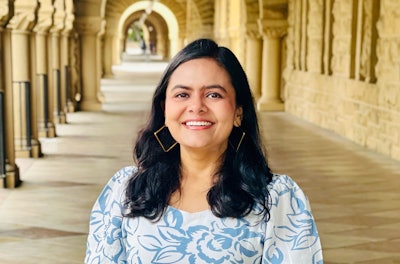
Arushi Bhardwaj, senior solutions analyst, Penske Logistics, LLC, was named a recipient of the 2025 Women in Supply Chain award, presented by Food Logistics and Supply & Demand Chain Executive, and sponsored by Let’s Talk Supply Chain, in the Rising Stars category.
Bhardwaj brings a rare combination of technical expertise, global perspective, and grounded innovation to the evolving world of supply chain technology.
With over 11 years of experience working across markets in five continents, she serves as senior solutions analyst for Penske Logistics’ freight management team, where she leads and supports TMS implementations and customer launches, helping customers gain visibility, streamline operations, and scale effectively.
Her journey into the supply chain world started unexpectedly. After earning her degree in Electronics and Communications Engineering, she joined Caterpillar as a support analyst, solving issues across 45-plus facilities and 2,500-plus suppliers. She developed into a skilled techno-functional expert, leading major TMS upgrades, building API and EDI integrations, and presenting fleet optimization models that reduced manual effort and improved visibility.
She later joined Blue Yonder, where after just a month into her new role, Bhardwaj went to Australia to design and implement Blue Yonder’s Intelligent Fulfillment and Transport Visibility solutions for the country’s largest supermarket chain, which operates 995 stores, as part of an $80 million program. Following that success, she went on to lead a $212 million global TMS rollout for a major eyecare company, building a custom parcel solution from scratch. For a Fortune 50 FMCG client, she identified $5 million in savings potential in Japan. At PepsiCo, she worked on dedicated fleet optimization in Egypt, projecting $100,000 in annual cost savings.
Over the past year, Bhardwaj has served as the IT solutions lead on a large-scale TMS implementation for a global leader in the health, nutrition, and beauty space. The project involves onboarding multiple business units, each with unique ERP systems, integration APIs, distribution networks, and business rules. To date, she has implemented four business units, representing a combined freight spend of $52 million. In parallel, Bhardwa is also playing a key role in Penske’s enterprise-wide initiative to digitize LTL transportation processes. The project involves designing and implementing a scalable solution that connects Penske’s diverse customer base to a broad network of LTL carriers. Her responsibilities span solution architecture, complex API mapping, and test coordination with third-party carriers.
Marina Mayer, editor-in-chief of Food Logistics and Supply & Demand Chain Executive and co-founder of the Women in Supply Chain Forum, sat down with Bhardwaj to detail her role in digitizing LTL transportation processes, why supply chains will look very differently in 2026 and how her journey mimics that of Karate Kid.
Food Logistics and Supply & Demand Chain Executive: Let’s first talk about you. Tell us about yourself and your journey in how you got to this current stage in your career.
Arushi Bhardwaj: I was born and raised in India, where my family still lives today. Growing up, I loved both science and math and in India, that often meant choosing between medical school or engineering. I chose engineering because solving equations came more naturally to me than memorizing complex biological names. Electronics and communications became my major, since India was fast becoming a lucrative market for global electronics companies and I wanted to be part of that revolution.
After completing my degree, I found myself on a very different path of building a career at the intersection of technology and supply chain, a field I hadn’t planned on, but one I have grown deeply passionate about. Each role since then has added a new dimension and those experiences have shaped my approach to problem solving.
My journey has been a bit like The Karate Kid, starting with the fundamentals, honing skills step by step and gradually being trusted with bigger challenges. I started at Caterpillar in a support role and then very quickly built my technical acumen by owning upgrades and developing applications. Over time, I transitioned into a techno-functional role for the transportation management system, where I was not only building complex system integrations but also interacting directly with customers. This experience gave me early exposure to how technology impacts real-world operations, teaching me to tailor my communication for each customer to ensure they clearly understood complex solutions. This made the process more collaborative and effective.
My time at Blue Yonder was a turning point. I went from being a strong techno-functional contributor to someone who could lead large, global implementations and translate complexity into clear, actionable solutions. It was also where I stretched myself the most by running proof-of-concepts, conducting optimization feasibility studies, and testing various new product offerings, all while designing and building solutions that could scale. That combination of experimentation and execution gave me both confidence and perspective to operate at an enterprise level.
At PepsiCo, I gained exposure to the fast-moving consumer goods (FMCG) supply chain characterized by rapid turnover, high consumer demand, and low-cost structures. This experience challenged me to adapt quickly and think critically about how technology and process design can deliver efficiency at scale.
Today at Penske, I am exploring the world of a global lead logistics provider, where the scale is immense, the challenges are layered, and the opportunities to shape the future of freight management are significant. What excites me most is the freedom to lead projects with full ownership, from conception to completion. Penske’s leadership has trusted me with that autonomy, and it has allowed me to deliver enterprise-wide initiatives, customer launches, and complex integrations with both accountability and creativity.
Each stage of my career has built on the last - from technical foundations to global exposure to enterprise leadership - preparing me to thrive in the role I hold today.
Food Logistics and Supply & Demand Chain Executive: Walk me through some of the challenges you personally have faced in the industry, and what you did to turn those challenges into opportunities.
Bhardwaj: The first major challenge came early in Caterpillar. I was asked to lead the end-to-end development of Caterpillar’s first integration between its transportation management system (TMS) and FourKites, a real-time visibility provider that would shape the company’s digital freight visibility roadmap. It was a critical, high-visibility project and my first full development assignment, which I had to deliver independently under tight timelines. During testing, I discovered that while the application was functional, it wasn’t optimized for scale. I re-engineered the data flows using asynchronous processing and multithreading to achieve the required performance benchmarks. The system went live on schedule, earned the highest quality score in my team, and had zero post–go-live defects. That project taught me that gaps in experience can become accelerators for growth when paired with persistence and curiosity.
At Blue Yonder, the challenge shifted from technical to strategic. I was tasked with conducting an optimization feasibility study for the Japan market of a Fortune 50 FMCG company using Blue Yonder’s Transportation Modeler. The goal was to evaluate truck building with multiple customers and inter-site deliveries using the highest base rate and to maximize vehicle fill rate. The stakes were high. If successful, the project could save the customer $1 million annually and secure a major statement of work for Blue Yonder. Working single-handedly under a tight deadline, I immersed myself in the customer’s network, simulated every scenario, and refined the model until it worked seamlessly. When I presented the results, the customer was elated and signed the contract immediately. That experience reinforced my belief that well-tested, data-driven design can deliver measurable business value.
Now at Penske Logistics, the complexity has expanded to an enterprise scale. I am leading a multi-phase customer implementation with sequential rollouts representing $78M in North America freight spend. Each business unit operates almost like its own company, with distinct ERP systems, APIs, carrier networks, and business rules. The real challenge lies in maintaining continuity across the ecosystem because every new rollout can trigger a domino effect that impacts integrations already in production. In addition, Penske has its own freight management standards and digital frameworks that must remain consistent.
I approached this not as a single project but as building a scalable integration architecture for Penske’s future customers. The outcome was more than successful deployment. It created a repeatable enterprise model for complex, multi-unit customers. This experience deepened my understanding of what enterprise leadership in supply chain technology truly means - designing systems that bring order to complexity and scale sustainably across the network.
Food Logistics and Supply & Demand Chain Executive: According to your nomination, your journey into the supply chain world started unexpectedly. Tell us more.
Bhardwaj: My background is in electronics and communications engineering, and when I chose that path, I thought I would build a career in hardware design. Supply chain was never part of my plan. That changed when I joined Caterpillar’s logistics information systems team almost by chance and what I thought would be a short detour ended up becoming the foundation of my career.
I didn’t feel out of place stepping into logistics. In fact, I found it quite meaningful. As consumers, we often only notice supply chains when something goes wrong, like a late delivery. But once you see them in action, you realize how much effort it takes to keep things moving every single day. Whether its ensuring gifts are delivered during the holiday rush or essential goods are supplied during a global pandemic, the undeniable value of a supply chain ecosystem becomes clear. It takes the right technology, streamlined systems, and committed supply chain professionals working together to make it happen, allowing people to stay safe and celebrate. Recognizing that collective effort is what inspired me to build my career in this field.
To deepen my knowledge in this field, I pursued MITx Supply Chain Management certifications. That’s when I learned that supply chain isn’t just about moving goods from A to B. Rather, it’s a complex mathematical problem that can have many variables. My engineering background turned out to be an advantage. Systems thinking and analytical skills helped me design optimized networks across thousands of suppliers, plants, and distribution centers.
I came into supply chain by chance, but I stayed because I could see the direct impact technology has on businesses, people, and everyday life. Looking back, what started unexpectedly gave me global perspective, resilience, and adaptability and it showed me that some of the most meaningful career paths aren’t the ones you plan, but the ones you grow into with curiosity and intention.
Food Logistics and Supply & Demand Chain Executive: Over the past year, you’ve played a key role in Penske’s enterprise-wide initiative to digitize LTL transportation processes. Walk me through what this entails.
Bhardwaj: Less-than-truckload (LTL) is one of the most highly fragmented segments of freight with hundreds of carrier partners, each operating on different systems, formats, and levels of digital maturity. At the same time, Penske’s customer base is equally diverse, spanning multiple industries, ERP systems, and business processes. The industry as a whole needs LTL digitalization because shippers and carriers alike are under growing pressure to scale efficiently, meet rising expectations for real-time visibility, and build supply chains that are more resilient and sustainable.
That’s why LTL digitization has become a strategic priority and a key focus area for Penske’s freight management team, fully aligned with our mission of simplifying complexity and delivering smarter, more resilient supply chains.
Over the past year, I have played a key role in architecting this enterprise-wide solution. Rather than a “one size fits all” approach, we are piloting standardized digital connections with our LTL carrier partners while designing a scalable, automated framework capable of flexing to both sides of the network - carriers with widely varying levels of digital readiness, and customers whose data and business processes are equally complex and unique.
My work has spanned enterprise solution architecture, multi-layered API orchestration, and end-to-end integration design, while also aligning internal operations, customers, and external technology partners. The challenge has been not only technical but also strategic - harmonizing disparate data flows, balancing standardization with flexibility, and ensuring that each pilot validates a methodology we can replicate globally.
Though still in pilot stage, the initiative has already delivered a significant validation of our solution architecture and integration methodology with select carriers and customers. It is setting the stage for enterprise-wide rollout and unlocking future innovations in automation, AI-driven exception management, and sustainability reporting.
For Penske, this initiative is about advancing our mission of turning complexity into clarity and enabling both shippers and carriers to operate confidently in a digital-first supply chain. For me, it reinforces my belief that impactful change comes from practical, well-designed solutions that balance all stakeholder needs - taking complex challenges, breaking them into manageable steps, and delivering outcomes that improve operations today while driving growth for the future.
Food Logistics and Supply & Demand Chain Executive: What are your Top 3 predictions/trends for supply chain and logistics come 2026?
Bhardwaj: By 2026, supply chains will look very different from today. The biggest changes will come from the rise of agentic AI, the shift toward building true resilience by design, and the acceleration of sustainable and electric freight solutions. Together, these mark a move from reactive logistics to intelligent, purpose-driven networks.
1. Agentic AI becomes part of everyday logistics.
Artificial intelligence is moving beyond dashboards and pilot programs into daily decision-making. Agentic AI systems will act as intelligent copilots - monitoring shipments, forecasting disruptions, and even recommending or executing corrective actions in real time. Humans will stay in the loop, but AI will handle much of the reasoning, coordination, and orchestration work that slows down operations today. The result will be faster responses, better accuracy, and more time for people to focus on what truly requires judgment.
2. Sustainability and electrification go mainstream.
Sustainability will no longer be an annual report topic. It will become a daily operating principle. Electric vehicles will expand in regional and last-mile networks where they make the most sense, and emissions data will sit right next to cost and service metrics in every logistics decision. The best supply chains will find ways to deliver greener operations without sacrificing speed or reliability.
3. From resilient to antifragile networks.
By 2026, supply chains will move beyond resilience - bouncing back from disruption - to antifragility, where networks get stronger through uncertainty. Instead of redesigning every few years, companies will use real-time data and advanced modeling to continuously stress-test their supply chains, adjust sourcing, and rebalance inventory. Disruptions like port congestion or shifts in demand won’t just be absorbed. They will become learning moments that sharpen future performance. To support this, shippers will increasingly turn to dynamic freight brokerage networks for flexible capacity, replacing static carrier commitments with agile, on-demand options. The shift to antifragile design marks a major evolution in how networks are built and optimized.






![Pros To Know 2026 [color]](https://img.sdcexec.com/mindful/acbm/workspaces/default/uploads/2025/08/prostoknow-2026-color.mduFvhpgMk.png?ar=16%3A9&auto=format%2Ccompress&bg=fff&dpr=2&fill-color=fff&fit=fill&h=135&q=70&w=240)
