For most of its history, procurement has been a reactive function. A shortage appears; a buyer expedites. A PO needs to be placed; a buyer places it. The work was transactional by design: process the requirement, execute the decision, move to the next fire.
Agentic AI is changing that design at the foundation by shifting the buyer's role from reactive executor to strategic analyst. The new procurement professional is someone who runs procurement as a series of deliberate, measurable campaigns and is in an ongoing collaborative conversation with an AI that gets smarter with every cycle.
This is the new procurement loop: Decide. Act. Learn. Repeat.
The campaign model
The shift starts with how work gets organized. In traditional procurement, the buyer's day is shaped by whatever is loudest: the most urgent shortage, the supplier who called, the planner who escalated. Priority is determined by noise, not value.
In the campaign model, priority is determined by data, driven by an advanced analytics engine built on deep supply chain domain expertise.
An analyst begins by running the inventory action engine, a system that generates specific, optimized actions across the entire parts portfolio: cancel this PO, move this one out, split this order, adjust this order policy. These actions are not generic recommendations. They are calibrated against optimized inventory targets and order policies, with a calculated ROI for every single item.
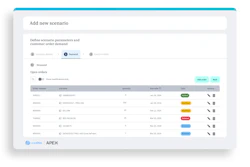
From that universe of actions, the analyst creates a single campaign. Not everything at once, because that is where most AI implementations fail. This campaign is deliberately focused: the Top 25 excess inventory items where POs can be actioned before the end of the quarter, or the critical shortages threatening shipments in the next seven days. Each campaign has a defined scope, a start and end date, and a measurable ROI target.
This is where the mental model shifts. Procurement is no longer a backlog to manage; its become a series of deliberate strategies to execute. Launch the campaign, measure the result, understand what did not get resolved and why, then sharpen the next campaign accordingly. The discipline that matters is not how many parts you touched this week. It is whether the parts you touched were the right ones, and whether the team learned something that makes next week's strategy more precise.
A real-world example
Abstract frameworks only matter if they work in practice. Safety stock is a concrete example of how the campaign model changes outcomes in ways traditional procurement cannot.
An analyst filters the full action list using a workbench that pulls a specific pattern from across the entire dataset. In this case, the workbench surfaces every part that is the last remaining item blocking a customer order from shipping this week. The analyst uses this to define the campaign scope and strategy. Once launched, the campaign delivers prioritized actions that are then executed, tracked, and measured.
Across thousands of parts, that filter surfaces ten. The buyer's immediate instinct is correct: expedite all ten, get them here, ship the order. Those actions go into their system immediately.
But the analyst looks at the same 10 parts and sees something that the expedited action will not fix. For nine of the 10, safety stock is set far too low, which is why these parts keep becoming the critical item blocking final assembly. The AI surfaces the recommended order policy changes alongside the expedite actions, with the projected carrying cost savings and time-to-impact for each one.
Two things happen simultaneously. The buyer fixes the immediate problem. The analyst fixes the systemic one. One campaign, two layers of resolution, and the next time that process runs, fewer parts appear on the list.
This is the feedback loop made concrete. The action addresses today's fire. The policy change prevents tomorrow's.
How skillsets will change
The transition from firefighter to strategic analyst does not require entirely new capabilities. It requires that experienced buyers apply skills they already have in a fundamentally different direction.
The ability to pattern-match and prioritize, which experienced buyers have developed over years of practice, is exactly the skill the campaign model amplifies. The difference is that they are no longer consumed by triage. Now, buyers and analysts have the space to think more strategically, identifying which 25 parts represent the greatest opportunity this week, and what the team might learn from acting on them.
The more challenging new skill is root cause analysis of actions that did not get resolved. When a recommended action comes back marked “unable to complete”, it’s an opportunity to learn more about what this tells us about order policy, the campaign scope, the underlying data, or the supplier relationship. This is an opportunity to test something new next week. The discipline of turning execution gaps into system improvements is the feedback loop in human form.
Experienced buyers are among the best AI trainers. Their institutional knowledge of supplier behavior, demand patterns, and operational constraints is exactly the domain expertise that makes the action engine more accurate over time. The AI automates the playbook. The experienced buyer both helped write and edit it.
Measuring ROI at every step
One of the most persistent failures of enterprise AI investments is the inability to demonstrate ROI at a sufficiently granular level to justify continued investment. According to MIT Project NANDA's The GenAI Divide: State of AI in Business, roughly 95% of enterprise generative AI pilots delivered little to no measurable P&L impact.
The campaign model solves this by design.
Every campaign produces a measurable result. Moving a PO out by 60 days on a $25,000 order at an 18% carrying cost rate produces a calculable working capital impact. Reducing safety stock from 100 units to 5 units, captured before the excess PO is triggered, produces a calculable inventory reduction. These are not promised benefits on a business case slide. They are actual outcomes at the part level, summed across every campaign, visible to every stakeholder.
The compounding effect is where the real case gets made. And while 25 parts per week sounds modest, that is 150 of the highest-priority opportunities at a single manufacturing site over six weeks. According to the 80-20 principle, those 150 parts may account for 60% of the total excess inventory opportunity. And as the procurement team becomes more fluent with the campaign model, the pace accelerates from 25 parts per week to 50, to 100, each cycle faster and more precise than the last.
The key is not to do too much, too soon. Prioritize, start focused, execute fast, measure every step, and build from there.
A never-ending conversation
What makes this model different from previous generations of procurement technology is the combination of advanced analytics that surface the right priorities, AI that generates and explains the actions, structured workflow that ensures execution and captures what did not get done, and a collaborative loop that makes the entire system smarter with every cycle.
This is what the shift from firefighter to strategist actually looks like in practice. The analyst is now directing an ongoing conversation with an agent that explains its reasoning, surfaces signals the buyer or analyst would not have seen alone, escalates what needs human attention, and learns from every action taken and every action skipped. When a buyer needs to understand why an action was generated, the AI explains it. When an exception needs escalation, the AI identifies who should handle it and why.
That is not a tool. That is a thought partner, one that is always available, always current on the data, and always getting smarter from the conversation.
The procurement teams that learn to work this way stop firefighting. They start leading.