Most supply chain and manufacturing leaders aren’t losing sleep over science fiction scenarios where robots take over the warehouse. Instead, they worry about having 5,000 nuts and only 20 bolts. They worry about a production order going sideways at the end of the week. They worry about critical operational data trapped in spreadsheets and compliance reports that take days to compile.
AI in the supply chain isn’t about replacing workforce—it’s about giving teams greater, real-time visibility. It’s the system that flags a margin anomaly before it becomes a massive financial problem. When technology handles routine, rules-based, and repetitive tasks, your people can focus on the complex judgment calls and customer relationships that drive the business forward.
AI enables us to move from a reactive posture to a proactive one. Shifting from asking “what happened?” to “what is about to happen, and what should we do about it?” changes the entire operational game.
Beyond the hype: Real operational solutions
The gap between early AI adopters and everyone else is producing real business outcomes. In fact, 58% of manufacturers say AI adoption and integration is their top business priority for the year ahead. As companies double down on AI, they’re unlocking new efficiencies that reduce costs, improve inventory management, and free up capital for strategic investments.
Early adopters are also reporting logistics cost reductions of up to 15% and inventory improvements of up to 35%. As machine learning detects production patterns and maintenance needs that human eyes miss, the factory floor becomes significantly smarter. Demand forecasting, quality control, and predictive maintenance all streamline operations and support growth.
ERP is your intelligence layer
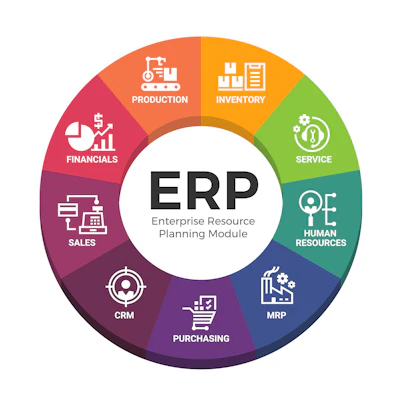
The enterprise resource planning (ERP) platform has transformed from a system of record to the intelligence layer where your data lives and where AI works. A modern, scalable ERP system activates AI across the shop floor in several critical ways.
AI-driven scheduling can predict bottlenecks before they hit the floor. For example, if a supply swing threatens a key component, the system surfaces alternatives in real time rather than waiting for someone to notice. Quality and compliance tracking shifts from a scramble to a single button click, with dashboards continuously monitoring OSHA and EPA standards. Inventory forecasting moves from static spreadsheets to dynamic models that match raw material orders to actual predicted demand. And on the labor side, AI can optimize scheduling and flag unsafe patterns before injuries occur — not after.
When you integrate these functions into a single platform, you eliminate redundant software licenses and reduce overall operational costs.
The foundation: Why data quality matters
The one thing that will derail an AI investment faster than anything else is bad data. Feed the system inaccurate information, and it won’t just fail quietly; it will automate your mistakes at scale.
An ERP system is the heart of organizational data. Every transaction, inventory movement, and customer interaction flows through this hub. You can’t have smart analytics without secure, accurate, and timely data that ERP delivers. This is a fundamental process and data hygiene requirement.
Many mid-sized companies sill have data living in silos. In the age of AI, your warehouse management system, quality control software, and transportation platforms must communicate with each other. When you break down data silos and create unified access to data, you unlock collaborative intelligence across your entire supply chain.
Managing by exception, not exhaustion
You likely process thousands of transactions every day. Finding an error in that volume is like finding a needle in a haystack. Often, things slip through the cracks. For instance, a margin quietly erodes over three weeks, or a production order runs 20% over budget without anyone noticing until the month-end close.
Machine learning scans these thousands of production transactions in real time, automatically flagging anomalies and manufacturing data outliers the moment they appear. If a margin drops below your baseline, the system highlights the specific order and surfaces the data you need to investigate.
This automation empowers your team to manage by exception rather than by exhaustion. You stop revenue leakage the moment it starts. Your staff spends less time buried in manual reports and more time acting on the insights that protect your ROI.
Securing your competitive advantage
When bringing AI into your core systems, data security is paramount. Your competitive intelligence, proprietary formulas, pricing strategies, and sensitive customer lists and information must remain under your strict, human-in-the-loop control.
Modern ERP solutions using private large language models ensure your proprietary data never trains public domains, so your information stays within your secure environment.
Integrating AI into a modern ERP system is an immediate opportunity to make operations more intelligent and efficient. The companies that pull ahead will be the ones who ultimately put their data to work. That starts with giving teams tools that surface the right information at the right moment, so they can make decisions instead of just managing noise.