Automation and robotics are rapidly reshaping warehousing, particularly in food and beverage operations, where cold chain integrity, speed to shelf, and order accuracy are mission critical. As these technologies proliferate, the industry faces a defining question: Will robots replace people, or will they redefine the role of the human workforce?
Working closely with employers across one of the nation’s fastest-growing logistics corridors – the answer is clear -- robots are not eliminating the workforce. They are elevating it. And that elevation requires deliberate investment in skills.
Humans and machines: A complementary model
Warehouse robotics adoption continues to accelerate. According to a report from the International Federation of Robotics, professional service robot sales climbed nearly 10% in the most recent reporting cycle (2024), with logistics representing one of the fastest-growing segments. Interact Analysis projects sustained, double-digit growth in mobile robot deployments across warehouses through the decade.
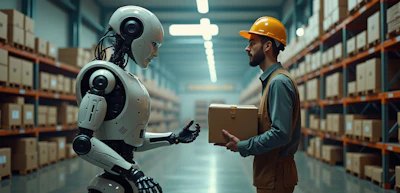
Autonomous mobile robots, automated storage and retrieval systems, and AI-enabled picking technologies are increasingly common in modern distribution centers. Yet, even the most advanced facilities are not “lights-out” warehouses. Instead, the prevailing model is collaborative: robotics handle repetitive, physically demanding or precision-dependent tasks, while humans manage oversight, exceptions, quality control and system optimization.
As Food Logistics has reported in its coverage of collaborative robotics, operators are seeing the greatest gains when humans and automation work in tandem rather than in isolation.
For food and beverage warehouses, this balance is especially important. Temperature-controlled environments, strict compliance standards and fluctuating demand cycles require human judgment. Robots can execute programmed workflows at scale; people interpret nuance, solve unforeseen problems and protect product integrity.
Automation changes the nature of work, it does not remove the need for it.
Labor pressures driving change
The shift toward automation has not occurred in a vacuum. Employment in warehousing and storage has climbed steadily, yet employers continue to report recruitment and retention pressures.
At the same time, supply chain leaders routinely cite workforce constraints as a top operational risk, per industry surveys. Automation offers part of the solution. By reducing repetitive strain and injury-prone tasks, robotics can improve safety and job quality.
But, it also introduces new demands. The warehouse of today (and certainly tomorrow) requires:
- Robotics maintenance technicians
- Automation and controls specialists
- Warehouse management system analysts
- Data-driven operations supervisors
- Cross-trained team leads capable of human-machine coordination
These are higher-skill, higher-wage roles. They demand technical literacy, mechanical aptitude, digital fluency and systems thinking. The workforce conversation must evolve accordingly.
Skill development as a strategic imperative
Technology implementation without workforce preparation is a missed opportunity. Existing findings suggest that while automation will continue to displace certain tasks, it will also create new roles requiring advanced (often technical) skills; in this case, it will be in maintenance, data analysis and systems management.
The most successful food and beverage operations understand that robotics ROI depends as much on human capability as it does on equipment performance.
That is why forward-thinking employers are prioritizing customized workforce training aligned directly with their automation platforms and operational needs. In practice, that means:
- Hands-on training with robots and automated picking systems
- Mechatronics and industrial maintenance pathways
- Safety training tailored to human-robot interaction
- Data and analytics literacy embedded into frontline roles
- Stackable credentials that create clear career progression
When employers partner with education and training providers to develop programs specific to their facilities, the impact is measurable: reduced downtime, faster onboarding, stronger retention and a more agile workforce prepared to adapt as technology evolves.
In North Carolina, employer-aligned customized training models help companies implement automation more confidently and at scale. The lesson extends beyond any single state. Simply put: workforce strategy must move in tandem with capital investment.
Elevating the quality of work
There is another dimension to this workplace evolution that deserves attention: Automation can improve not only productivity, but also the quality of warehouse careers.
When robotics take over repetitive lifting, long travel distances and hazardous tasks in cold environments, human workers are freed to perform work that is more analytical, supervisory and value-added. This shift can reduce injury rates, improve morale and create clearer advancement pathways.
For food logistics operators competing for talent, that matters. A warehouse equipped with modern automation – and supported by visible training pathways – becomes more attractive to prospective employees. It signals innovation and long-term opportunity rather than short-term labor shakeups.
Preparing for what’s next
The pace of innovation in AI-enabled logistics will only accelerate. Predictive analytics and increasingly autonomous systems, for instance, are already entering the market. The competitive advantage will belong to companies that treat workforce development not as a reactive necessity, but as a proactive strategy.
The future of warehousing, especially in the food and beverage space, is humans with robots. Machines extend capability; people provide adaptability, judgment and innovation.