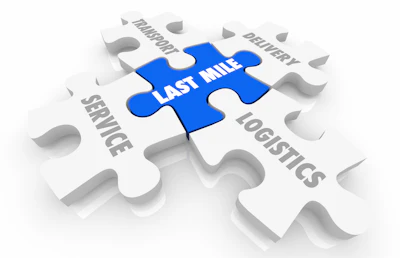
The last mile is often described as the final step in the supply chain, but that undersells its complexity and its business impact. With rising customer expectations, i.e. same-day or next-day delivery, real-time visibility, narrow time windows, the last mile has become the most tenuous and risk-exposed part of the operation.
The last mile is the culmination of preparation, conversations, and relationships that are tested in the real world, where variables come out of left field; demands shift by the minute, and human needs become apparent. While technology can help, risk is unavoidable.
The last mile of the supply chain isn’t challenging because of distance or speed; it’s that every day and every situation is different. Companies that survive, and better yet, thrive in the last mile recognize this early. They treat the last mile as a discipline that requires constant coordination and refinement between team members and technology, while analyzing risk.
Why the last mile is so fragile
Middle-mile or long-haul transportation is fairly repeatable. A truck moving between warehouses follows the same route every day, and if there is a change in traffic, it’s easy to reroute it. The variables are limited and, mostly, predictable.
The last mile, however, involves variable delivery locations, new routes, and changing time requirements – this is the part that lacks repeatability.
Matching human capital needs is the hardest part of last-mile operations. You need drivers available exactly when a customer demands, which is tricky when accounting for idle capacity when a customer isn’t in need. Requests are often last minute, and customers need urgency.
Every idle driver raises costs. Every missed pickup or delivery erodes trust and increases downstream costs. It’s quite the conundrum.
Layer in uncontrollable factors like winter storms, traffic, and road closures, and even the best-laid plans can unravel quickly. A single delay can cascade across an entire route. As delivery windows become narrower, the margin for error disappears.
All these factors contribute to the last mile breaking. It’s not inefficiency, it’s ongoing exposure to real-world variables that can’t be controlled.
Time sensitivity changes everything
Also underestimated? Time requirements. This adds another layer of complexity that many companies struggle to navigate.
End-of-day delivery is very different than a window-based time allocation. Narrow delivery windows are exponentially harder to route and recover if something goes wrong.
When a delivery has a higher level of time sensitivity, last-mile delivery focuses more on speed and less on precision. One delayed stop can put the rest of the route at risk. At that point, the last mile stops being a transportation problem and becomes a coordination problem.
Where technology helps and where it doesn’t
Technology is crucial to last-mile operations, but it can’t always handle the complexity (its value depends on where it’s used in the operation).
Driver-facing tools, such as navigation, task lists, and proof-of-delivery, are relatively straightforward. When a driver gets the assignment, the who, what, where, and when are clear.
Dispatching is the complex piece of the puzzle and remains deeply human-led. Automated routing and dispatching tools struggle to account for the nuances of specific delivery needs. Human dispatchers have operational knowledge that software can’t always capture, which customers are consistently late, which location needs extra time, which deliveries need to happen early for space or time constraints, and even variables like which buildings lock doors at what time.
Dispatchers can adjust in real time and have the experience to balance service among customers simultaneously. The best bet is simply giving dispatchers better tools to help balance the complexity of shipments and their variables – tools that provide clear visibility, intuitive interfaces, and adjustments that flow directly to drivers.
Technology should empower human judgment, not eliminate it.
Automation and the road ahead
What can be automated? That’s the question industries across the board are asking. And the logistics industry is asking the same question when it comes to the future of last-mile delivery.
Driver-assisted and autonomous vehicles will soon play a big role in the future of the last mile. Already, systems are improving safety and reducing risk. Soon, self-driving vehicles will be handling more of the driving, including route optimization and traffic management.
The last mile should never be fully automated, though, as drivers do more than simply driving. They are the last experience your customers will have with your company - they navigate unexpected obstacles, observe and escalate potential issues, make the handoff and sometimes even physically package the goods when picking up from a healthcare customer. The human touch will always remain essential, even as automation advances.
While the capability may be there, the future shouldn’t rely on autonomous vehicles; instead, it should advance technology to enable drivers to operate with better tools, systems, and information so they can better operate in high-risk, high-variability environments.
The human factor: Recruiting and retaining couriers
While software and automation, no doubt, play a heavy role in last-mile delivery, it still relies heavily on people to navigate real-time issues before they escalate. That’s a lot of responsibility when handling high-stakes packages.
It is crucial that operators invest in long-term relationships with their teams and extended teams. The relationships pave the way for trusting communication that allows for real-time problem-solving when something goes wrong. Drivers need to know and feel comfortable escalating and asking for help.
A good courier possesses intangibles that are hard to screen for - intuition, the capacity to problem-solve, situational awareness, and common sense.
As with all roles, investing in training is important, too. Drivers who handle high-stakes packages need more than just a cut-and-dry onboarding experience. Often, ride-alongs, escalation paths, and real-time instruction help reduce mistakes before they happen.
Finding ways to retain drivers helps reduce overall risk. Tenured drivers understand routes, customers, and delivery needs, and build cohesion across dispatching teams. This becomes your competitive advantage.
Risk, insurance, and operating models
Risk mitigation is critically overlooked in last-mile delivery strategies. Operating models play an important role in managing deliveries and additional costs, like insurance requirements.
Different operating models have different tradeoffs. While flexible schedules and delivery timing can manage demand volatility, fixed scheduling improves consistency.
Whether you employ couriers or work with contractors impacts insurance coverage, liability exposure, and compliance needs. Depending on your operating model, these requirements can vary.
Alignment with your company and customers is what matters. Your level of risk and comfort should be discussed and acted upon proactively, and revisited as your company and networks scale.
Scaling the network
As last-mile operations grow, companies inevitably will face the question: Do you centralize dispatching or keep it local? There is no doubt an advantage that comes with local teams - historical knowledge of the roads, real-time weather updates, and customer familiarity. On the flip side, centralized teams are efficient, flexible, and have clearer career paths, without being idle if there are no local customers.
Hybrid teams can work well, too. Teams centrally assigned to consistent territories keep the familiarity while allowing the team to scale.
If you handle international shipments, however, local partners become essential. This further underscores the necessity of long-term relationships to ensure communication and quality control meet your standards. This is built over time, not through one-time contracts.
As always, intentional design, suited to your business and customer needs, is the most important. Thinking through your team structure a year or two in advance allows you to absorb complexity and grow faster.
Last mile as an operational discipline
A high-quality last-mile experience can’t be created by a single piece of software or algorithm. It’s created through relationships - between people and your systems that can absorb risk and the variables that come with the last mile.
Successful companies accept that the last mile is never fully predictable, but build systems that enable them to be nimble and adjust quickly when even the best-laid plans go awry.
Treating the last mile as a unique experience and as an operational discipline is what separates success from failure and allows your company to scale.