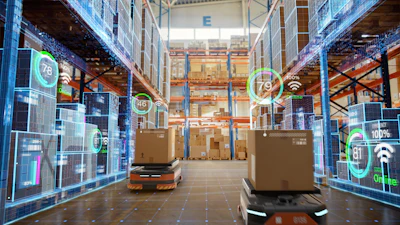
Robot orchestration is the coordination layer that enables multiple robots from different vendors to work together seamlessly in warehouses and manufacturing facilities. Rather than individual robot capabilities, orchestration determines whether automation investments compound over time or stall as complexity grows, making it essential for sustained performance and avoiding vendor lock-in.
- Companies are struggling not to acquire robots, but to make multiple robots from different vendors work together effectively.
- Orchestration platforms coordinate mixed fleets across brands and task types—something WMS or WES systems alone cannot achieve.
- Higher robot adoption correlates with statistically significant declines in worker injury rates, improving safety economics and total cost of labor.
- Three forces driving orchestration adoption: labor cost dynamics, vendor lock-in risk, and the rise of self-learning AI-enabled systems.
- The strategic difference is treating robotics as a governed system rather than isolated tools, enabling companies to reassign work and scale without rearchitecting operations.
Robotics in distribution and manufacturing isn’t new. What’s new is the volume and variety of robots entering facilities, and the reality that most organizations are already juggling multiple vendors, protocols, and task types (whether they planned to or not). One pattern is clear: companies aren’t struggling to acquire robots. They’re struggling to make them work together.
Take for example, a picker that moves through an aisle while a robot follows, hands‑free, collecting items. When that task is complete, the tote transfers onto an AMR and routes to the next step without any manual intervention, waiting, or handoff gaps. This was all within a 10‑minute span. The robots weren’t impressive because of what each one did individually. The impact came from how they operated together.
This is why orchestration matters. And why it matters now.
What’s changing inside facilities
Gartner has begun to recognize “multi‑agent orchestration” as a distinct vertical because companies are discovering the limits of relying on WMS or WES alone. A WMS can dispatch work. A WES can optimize a slice of execution. But neither can coordinate mixed fleets of robots across brands and task types. That gap is what creates diminishing returns: more robots, same bottlenecks.
· Leaders who already bought automation are asking why throughput didn’t increase as expected.
· Others are asking whether they need more robots or a different way of managing the ones they have.
· Many want to understand whether today’s investment will hold up as robotics vendors continue to evolve.
Companies want clarity on whether robotics decisions made today will lock them into a single vendor or leave them boxed in when their operational model shifts. Multi‑vendor orchestration exists for this exact reason: the landscape is changing too fast for any single fleet to carry the entire load.
The practical applications taking hold
In warehouse environments, the earliest wins show up in travel time reduction and safer workflow design. Large-scale research backs this up. Studies of U.S. industrial automation suggest that higher robot adoption correlates with statistically significant declines in worker injury rates, contributing to meaningful reductions in national workplace injury costs. Instead of pushing carts or moving pallets manually, workers have robots trailing behind them, handing off totes to AMRs that autonomously navigate to staging areas. On shop floors, orchestration is beginning to manage AGVs and AMRs assigned to assembly support and material movement.
The most consistent benefit is predictable flow. When robots operate as a coordinated fleet rather than as isolated tools, the human worker stops being the bottleneck and becomes the stabilizer—focused on quality, exception handling, and value‑add tasks rather than transit.
Why robotics orchestration is the hot topic now
Three forces are making orchestration unavoidable:
1. Labor dynamics: In working sessions, we repeatedly noted that labor is no longer cheaper than automation. The cost-benefit analysis has flipped, and a lot of the flip is tied to safety economics. A comprehensive case-study review found that manufacturing automation and robotics reduced workplace musculoskeletal injury risk and improved process productivity in most cases, materially changing the total cost of labor beyond wages alone. The industry can’t assume that adding headcount is easier than adjusting robotics.
2. Vendor lock‑in risk: As robotics innovation accelerates, choosing a single vendor becomes a liability. Companies want the freedom to replace or expand fleets without re‑platforming. Orchestration is the only practical insulation from that risk.
3. The rise of self‑learning systems: Team discussions highlighted that robots aren’t being manually programmed for every outcome. AI‑enabled fleets can adapt to new tasks, new routes, and new constraints. That makes orchestration — not hardware — the strategic layer.
The question is no longer whether robotics will reshape operations. It’s whether companies will build the architectural layer needed to keep pace with that reshaping.
What leaders should evaluate next
The companies asking the right questions are no longer debating “robots vs. humans.” They’re evaluating:
· How mixed fleets will communicate
· How throughput will be measured when humans and robots share tasks
· How safety, sustainability, and workforce upskilling will factor into ROI
· How orchestration platforms will integrate with their existing ERP and WMS environments and with modern data layers increasingly built on platforms.
Robotic capabilities are no longer the bottlenecks. The constraint now is coordination.
As fleets multiply and task complexity increases, the difference between incremental automation and sustained performance comes down to whether companies treat robotics as a collection of tools or as a system that must be governed. Orchestration is that governance layer. It determines whether robotics investments compound over time or stall out as complexity grows.
The leaders who get this right won’t be the ones with the most robots. They’ll be the ones who can reassign work, absorb change, and scale throughput without rearchitecting their operation every two years. In an environment where labor economics, vendor volatility, and operational risk are all tightening at once, orchestration isn’t a future capability. It’s how fulfillment stays adaptable without starting over.