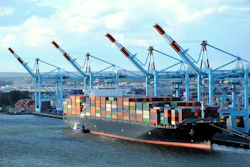
Container spot rates to North Europe have risen since early October, but European ports are now bracing for ships to arrive in clusters as Suez capacity returns faster than schedule reliability recovers, shifting the market from a disruption premium to a test of capacity management.
- Shanghai to Genoa rates rose 12.7% between October 8 and November 5, while Shanghai to Rotterdam rose 8.3%, yet both remain below general rate increases.
- Port of Antwerp-Bruges reported its strongest container quarter since late 2020 in Q3, with container throughput up 1.2% in TEU over the first nine months.
- The Genoa premium over Rotterdam widened from $359 to $551 per 40 feet in four weeks, reflecting uneven capacity and pricing across European ports.
- Extra-EU imports of goods rose 7.7% in January to August 2026, while the EU recorded a goods deficit of EUR 46.1 billion, down from a EUR 76.4 billion surplus a year earlier.
- Suez rotations are being rebuilt faster than expected, freeing capacity but creating clustering risks at European ports that must manage uneven arrivals.
Container spot rates from Asia to North Europe and the Mediterranean have risen since early October, but the evidence that carriers can make the increases stick is thin.
Drewry's Shanghai to Genoa assessment rose 12.7% between Oct. 8 and Nov. 5 and Shanghai to Rotterdam rose 8.3%, yet both remain below the general rate increases (FAKs).
At the same time, the return of services to Suez is freeing capacity faster than schedule reliability is recovering, and European ports are now preparing for ships to arrive in clusters, according to Sogese’s November Europe Container Market Update, indicating this as a shift from a disruption premium to a test of capacity management.
"The market is giving us two different signals. Freight rates have started rising, but there is still limited evidence that cargo demand has strengthened enough to support a lasting recovery. November will be important because it will show how much of the announced price increase carriers can secure from customers, rather than simply publish in their tariffs," says Andrea Monti, CEO and MD, Sogese.
Key takeaways:
· Port of Antwerp-Bruges reports its strongest container quarter since late 2020 in the third quarter, with container throughput up 1.2% in TEU over the first nine months, while total cargo was down 0.8% at 200.9 million tons. Port of Rotterdam reports total throughput up 0.9% in the first nine months, to 323.2 million tons.
· Eurostat reports that extra-EU imports of goods rose 7.7% in January to August 2026 against 0.4% for exports, and that the EU recorded a goods deficit of EUR 46.1 billion, against a EUR 76.4 billion surplus a year earlier.
· The Genoa premium over Rotterdam widened from $359 to $551 per 40 feet in four weeks. Fermerci reports that Italian rail freight traffic fell 8.1% in the first half of 2026, mainly because of PNRR works, and Trieste's rail movements fell 14.0% from January to September even as its container volumes rose 2.5%. ISTAT reports that Italian extra-EU exports fell 1.3% month on month in September, the second consecutive monthly fall.
· The report details a failure of the increases to reach market rates, and uneven capacity and pricing while Suez rotations are rebuilt. Hormuz remains the main risk to the picture, because an escalation could remove much of the capacity Suez returns.