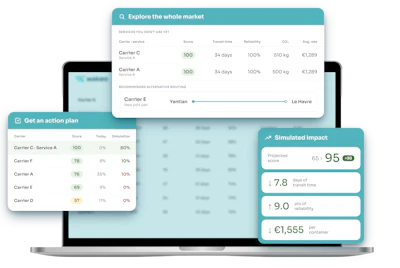
Wakeo launched Supply Chain Advisor, a new AI solution that recommends the best routes and transport options for each flow for shippers and freight forwarders, based on total cost and performance.
“Ten years ago, we built Wakeo to give companies real-time visibility on their shipments, so they could react fast to disruptions, cut emergency costs and keep customers satisfied. But one question kept coming back: how can we do better next time?” says Julien Cote, CEO and co-founder of Wakeo. “Supply Chain Advisor turns the data into decisions. A freight tender should not be a price negotiation alone. It should be the moment a company chooses the partners who will keep its promises to customers.”
“The advisor compares a company's actual results with millions of historical shipments across the market,” says Loïc Marzin, co-founder and CTO of Wakeo. “Our models predict how each route and transport option is likely to perform, then rank the options against the priorities each customer sets. The advisor recommends, and teams make the final decision, knowing the potential benefit of each choice before they commit.”
Key takeaways:
· Supply Chain Advisor combines two sources of data. Wakeo's real-time visibility shows how each transport provider performs on a company's own flows, across sea, air, road, rail and parcel. Trusted Routes benchmarks the routes and transport options available on the market. Teams then set what matters most to them: cost, reliability, transit time, exposure to disruptions or CO2 emissions. The advisor scores their current transport plan, highlights the weakest routes and recommends better options.
· Both teams see the same data on cost, reliability, transit time and risk, and make the call together. It works alongside the tendering tools and spreadsheets teams already use.