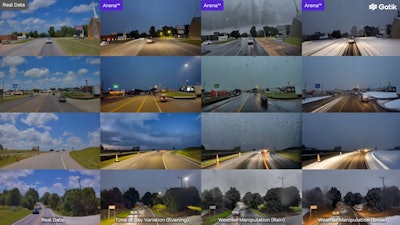
Gatik developed Gatik Arena, its next-generation simulation platform designed to accelerate the development and validation of autonomous vehicle (AV) systems. Built in-house and fine-tuned to Gatik’s operational and technical needs, Arena produces photorealistic, structured, and controllable synthetic data that directly addresses the limitations of traditional real-world data collection.
"As the AV industry pushes toward scaled deployments, the bottleneck isn't just better algorithms, it's better, smarter data,” says Gautam Narang, Gatik’s CEO and co-founder. “Arena allows us to simulate the edge cases, rare events, and high-risk scenarios that matter most, with photorealism and fidelity that match the complexities of the real world.”
Key takeaways:
· As Gatik scales freight-only (driverless) operations in 2025, Arena will enable safe and efficient training for its autonomous systems on a wide range of driving scenarios, from routine tasks to rare edge cases, reducing reliance on on-road testing and accelerating the safe, cost-effective commercialization of its solution for partners.
· Gatik collaborated with NVIDIA to integrate NVIDIA Cosmos World Foundation Models (WFMs), enabling the creation of ultra-high-fidelity, physics-informed digital environments for robust AV training and validation.
· Arena entails an extensible modular simulation engine that leverages strengths of advanced AI techniques (NeRFs, 3D Gaussian splatting, diffusion models) to enable scaling from quick scenario augmentation to high-fidelity, full-stack simulation, ensuring each component of the autonomy pipeline is trained and validated with the most optimal and resource efficient technique.
· It leverages neural techniques like volumetric reconstruction to create high-fidelity simulations from abstract representations such as segmentation maps, LiDAR, and HD maps; and supports modifying real-world logs.
· Other features include the visibility of accurate outputs; closed-loop simulation; structured synthetic data generation; adverse weather and visibility; unpredictable road users; challenging road geometry; dynamic road changes; sensor and perception failures; and dense urban interactions.