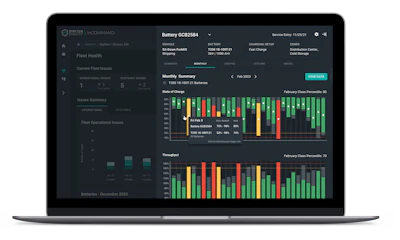
Effective battery management for material handling fleets requires aligning battery selection with actual duty cycles and operating requirements rather than upfront cost alone, while using performance data to optimize total cost of ownership across replacement frequency, maintenance, downtime, and productivity.
- Battery selection should match actual duty cycles, charging practices and operating requirements, not just upfront price
- Total cost of ownership includes replacement frequency, maintenance, downtime, charging efficiency and lost productivity—not just initial purchase cost
- Oversized or undersized batteries eliminate savings: too small causes frequent changeouts and premature replacement, while oversized increases capital costs without productivity gains
- Data-driven battery management tools provide continuous visibility into battery health and performance, helping identify issues before downtime occurs
- When procurement and operations teams share performance data, they make stronger sourcing decisions and adapt battery strategy as fleet demands evolve
As warehouse and logistics operations scale, operators face increasing pressure to control costs without sacrificing productivity. While labor, equipment and automation often lead cost-reduction conversations, battery management within material handling fleets is frequently overlooked.
When battery management practices are misaligned with actual usage, costs compound over time and often without clear visibility. This is where procurement, operations and battery management strategies intersect.
Key takeaways
· Battery selection should reflect actual duty cycles, charging practices and operating requirements, not upfront cost alone.
· When determining the total cost of ownership, replacement frequency, maintenance, downtime, charging efficiency and lost productivity should be included.
· Battery/material handling equipment performance data can help procurement teams improve sourcing decisions, manage lifecycle costs and reduce unexpected operating expenses.
Where fleets are losing money today
One of the most common procurement challenges is defining battery requirements before a fleet is deployed. Batteries are often selected based on upfront price or purchasing habits rather than actual performance needs.
A frequently overlooked factor is duty cycle, which is the pattern and intensity of battery use over time. A warehouse operating one shift with predictable traffic patterns has different energy demands than a high-throughput distribution center running multiple shifts with continuous equipment utilization. Assumptions about charging behavior, shift schedules and available charging infrastructure can also lead to battery selections that underperform in real-world conditions.
The most effective battery strategies align capacity with actual operating requirements.
Batteries that are too small can lead to more frequent changeouts, additional charging or premature replacement, quickly eliminating any upfront procurement savings, while oversized solutions increase capital costs without improving productivity.
Battery chemistry adds another layer of complexity. The right choice depends on how the fleet actually operates, and a mismatch can shorten battery life, reduce performance and create more unnecessary costs.
Driving more cost control
A battery's true value is determined by how effectively it supports operations over its service life. Replacement frequency, maintenance requirements, downtime, charging efficiency and lost productivity all contribute to total cost of ownership.
A lifecycle-value approach shifts the focus from upfront price to total operating cost. Organizations evaluate which battery solution will deliver the greatest operational value over time, revealing saving opportunities that traditional purchasing processes often miss.
Even high-quality batteries can underperform when deployed in applications they were not designed to support. Strong sourcing decisions are grounded in operating data, including utilization rates, shift structures, charging behavior, temperature of the operating environment, maintenance plans and productivity requirements.
What successful battery management looks like
The most effective operators use data to align battery decisions with actual fleet requirements. Battery management tools and maintenance programs provide continuous visibility into battery health, usage patterns and performance under real-world conditions, reducing reliance on assumptions, periodic inspections or manual records.
This visibility helps operators identify potential issues before they lead to downtime, extend battery life and improve equipment availability. It also gives procurement teams a clearer picture of which batteries consistently meet operational demands and whether they are delivering the performance expected and being used in the intended manner when sourcing decisions were made.
Over time, these insights can inform stronger purchasing strategies. Procurement teams can define sourcing criteria based on proven fleet performance, anticipate future requirements and evaluate suppliers on lifecycle performance rather than purchase price alone. This creates a more repeatable approach to battery management and sourcing that can adapt as fleets grow and operational demands change.
Bringing procurement and operations together
As material handling fleets become increasingly complex, battery management has evolved from a maintenance consideration to an important part of a broader fleet strategy. Procurement, operations and maintenance teams all play a role in ensuring battery investments deliver expected outcomes.
Shared visibility into battery performance data helps organizations make stronger sourcing decisions and manage lifecycle costs with greater confidence.
When procurement and operations work from the same performance data, battery strategy becomes a practical way to improve uptime, control costs and strengthen fleet performance.