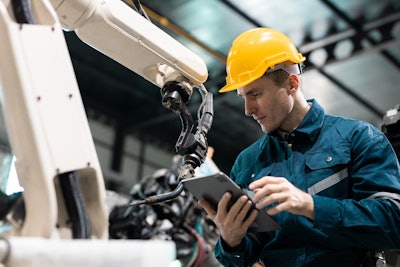
It seems like every day there’s a new AI breakthrough making headlines. Yet it was the advent of GenAI through platforms such as ChatGPT that truly showcased AI’s potential to bring new business value to the manufacturing industry. Early predictions had GenAI influencing nearly every aspect of work but we’re now starting to see real use cases for GenAI being a key productivity booster, especially for shop floor workers. This rise of AI-powered connected workers has the potential to address the current skilled labor shortages and make blue-collar jobs more attractive to the younger generation of digital native workers.
The manufacturing industry is no longer stuck in the past
Faced with a shortage of skilled workers, attracting Gen Z workers to the shop floor, which has traditionally been seen as dull, dirty, or dangerous (the three Ds of manufacturing), has proven an ongoing challenge. Then along came Gen AI, with new tech such as AV and VR that has transformed the traditional shop floor into a productive – and cool – place to work.
Manufacturers need to work to the highest standards. That means training, and reskilling frontline workers with different levels of knowledge, competence, and language issues—all while keeping practices health and safety compliant for the new tech-enabled manufacturing era. Enter Gen AI and the new generation of connected worker platforms, where content creation and delivery are in their DNA.
A balancing act between knowledge transfer and rising costs
From checklists and skills, to procedures and knowledge transfer—content creation isn’t a one-stop-shop. And with inflation on the rise—8.3% in the United States in 2023—taking workers away from their duties on the shop floor to create content is becoming a no-go area for management.
Creating content isn’t the only hurdle to overcome. Arguably, facilitating content retrieval on the shop floor is an even greater challenge.
From dark to dynamic – digital tools are the key to attract the next generation of Gen Z workers
Bringing new technologies, such as connected worker platforms and Gen AI to the shop floor is transforming the dark and dirty shop floor into a more engaging workplace. But as more manufacturers aim to recruit Gen Z workers, it’s essential to ensure all instructions are available on digital platforms. Younger workers are tuned in to search for answers and instructions digitally—so making content available digitally is critical to retain these workers, and empower them to take ownership of their role—a growing necessity for the younger workforce!
The rise of the AI-empowered workforce
1) Convert documents in a matter of minutes with digital work instructions
Frontline workers need content that can be easily and quickly understood and assimilated. That means it needs to be in multiple formats such as text-based instructions, but creating all this content takes a lot of time and capital. And it’s not all about new content. Factories will already have thousands of existing content files such as standard operating procedures and work instructions but converting each one into an easily accessible location is also costly and time intensive.
The full value of connected worker solutions can take time to materialize due to the time and effort required to import and build the required digital work instructions into the platform. Here comes AI to the rescue!
Streamlining the creation or conversion of each type of content using AI-powered content transformation will drastically reduce the amount of time it takes to provide digital or written instructions in one secure location. The ability to convert documents in a matter of minutes, into easy to comprehend Digital Work Instructions from lengthy, written standard operating procedures, will reduce deployment times, allowing for faster time to value.
2) Present workers with the right information at the right time
Concise communication and comprehension is key to helping improve worker and team productivity. When you’re working in a fast-paced and loud manufacturing environment, errors are naturally going to happen. But what if workers had a tool that could intelligently interpret the user's input, and beautify it by automatically improving its grammar, vocabulary, and punctuation to ensure optimal readability.
AI can empower workers to work smarter, not harder by providing them with intelligent search capabilities that not only grasps their inquiry's intent, but also adapts to human nuances like typos or vague terms. This ensures quick and accurate responses to inquiries like how to troubleshoot a broken mixing machine with a jammed mechanism. AI makes sure they are presented with the right information at the right time.
Some companies add embedded AI semantic functionality to improve their internal search engine, making it easier for users to find the content they need without needing to scroll through an entire content library, wasting valuable time on the frontline. An “Ask a Question” functionality, enabled by Gen AI, takes this search capability one step further to empower workers on the shop floor. Users can skip the time-intensive process of sifting through pages of information and instead find specific answers in a faster, and more intuitive way. This information sits within the knowledge articles created by the customer and will be referenced when searching for answers to eliminate any AI misinterpretations.
3) Access a step-by-step guide with AI-powered video instructions
Video is fast becoming one of the most consumed forms of content, especially for Gen Z. In fact, 57% of Gen Zers prefer to learn about new products by watching short-form videos.
So when it comes to creating digital work instructions, companies shouldn’t overlook the power of video to improve user engagement. But creating video-based instructions for shop floor workers is a challenge particularly for factories that lack sufficient financial and human resources.
But AI-powered video instructions changes all that. It can pull out relevant information and sequence it into structured written steps. Images can also be helpful to provide visual context at each step.
Workers can access a step-by-side visual guide on how to carry out a task. This helps to improve troubleshooting as operators can access a broader library of content. Younger workers can also benefit from the knowledge of senior operators in a way that engages them and meets their new workplace expectations.
4) Break down language barriers with intelligent transcription capabilities
Immigrant workers account for 2.92 million manufacturing workers in the United States, and the majority of these workers will not speak English as their first language. Despite this, most global manufacturers struggle to ensure that critical operational content is available in all the languages of their diverse workforce. But not anymore! AI-powered transcription can break down global language barriers and encourage worker inclusion—by translating all types of content into the required language.
This is an intelligent capability that automatically translates the audio from videos into relevant subtitles in the preferred language of the user. Not only does this reduce the effort to create and maintain content, but it also improves the comprehension and retention of information leading to better safety, quality, and productivity on the shop floor.
Superagency in the workplace is now a reality with AI
As AI capabilities continue to advance, its potential to revolutionize the manufacturing industry is undisputable. Yet future success depends on the integration of AI into core systems such as connected worker platforms.
AI is still working its way through the hype cycle, but practical applications are emerging daily, which are offering insights once thought impossible and improving skills across all levels, from the shop floor to the executive suite. The AI-empowered connected worker is a prime example of this evolution – and one that forward-thinking manufacturers shouldn’t miss out on.