In many yards at distribution centers and manufacturing plants, the unspoken priority is still speed at all costs. When peak volumes hit, trailers stack up and docks clog, pressure to move faster intensifies across every role. Shortcuts creep in. Spotters skip steps. Drivers rush maneuvers. Supervisors override procedures to clear space.
Over time, this environment erodes safety. Workers are caught between formal rules and informal expectations, unsure which truly matter in the moment. That tension fuels burnout, disengagement, and preventable injuries.
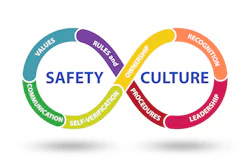
The strongest safety cultures remove this conflict entirely. They make it clear that productivity and safety are not competing goals, but interdependent outcomes of disciplined operations that shape daily behavior and long-term performance.
Historically, worker safety in distribution centers and manufacturing plant yards has been managed through checklists, audits, and periodic training refreshers. While necessary, those measures alone are no longer sufficient. As supply chains grow faster, denser, and more interconnected, risk multiplies across handoffs, systems, and human decision points.
Safety can no longer exist as a standalone program that is reviewed only once a quarter. It must become part of the operational ecosystem itself, embedded into how work is planned, communicated, and executed every hour of every shift.
Increasingly, safety failures in the yard do not remain confined to the facility. They surface as executive-level concerns involving liability, insurance exposure, reputational risk, and board oversight. What happens in the yard now carries enterprise-wide consequences.
Why the yard has become a safety flashpoint
Nowhere is this evolution more urgent than in the yards at distribution centers and manufacturing plants.
These yards sit at the intersection of transportation, warehousing, labor, and equipment. Trucks, yard tractors, pedestrians, dock workers, and automation converge in close proximity under compressed timelines and constant pressure. It is also where some of the most serious safety hazards in the supply chain reside.
Modern facilities bear little resemblance to the environments safety programs were originally designed to protect. Operating windows have tightened, variability has increased, and the pace of activity has accelerated. Even small missteps can escalate quickly.
The future of worker safety does not hinge on more rules alone. It depends on better systems and a deeper organizational commitment that connect safety outcomes directly to operational decisions, from gate activity to dock scheduling to yard movement patterns, in real time.
Operational complexity is redefining risk
Several forces are converging to elevate safety risk.
SKU proliferation has multiplied trailer types and handling requirements. Appointment schedules are tighter. Retailers demand higher OTIF performance. Cold chain freight adds urgency and compliance pressure. At the same time, labor shortages and high turnover mean many facilities operate with a less experienced workforce.
These pressures collide in environments where visibility is limited and communication is fragmented. Drivers arrive early or late. Trailers are staged incorrectly. Yard tractors are reassigned mid-task. Pedestrians cross travel lanes to retrieve paperwork.
Each action may seem minor in isolation. Together, they create a persistent and escalating risk environment.
Most safety incidents in the yard are not caused by a single reckless act. They stem from system-level failures such as poor visibility into trailer locations, unclear move prioritization, inconsistent communication, or manual processes that cannot keep pace with real-world variability. Human error is often the final link, but rarely the root cause.
In high-pressure environments, workers are forced to make rapid decisions with incomplete information. Over time, this erodes psychological safety and increases the likelihood that individuals will take risks rather than pause for clarification. Reducing uncertainty is therefore a direct safety control, not just an efficiency improvement.
From reactive safety to predictive safety
Traditional safety programs focus on lagging indicators such as recordable incidents, lost-time injuries, and days without an accident. These metrics are important, but they describe what has already gone wrong.
Predictive safety shifts attention to leading indicators that signal elevated risk before an incident occurs.
In the yard, these indicators include gate congestion, prolonged trailer dwell, repeated rehandles, missed shift handoffs, equipment shortages, and frequent reprioritization during peak periods. These conditions are not merely productivity challenges. They are early warnings of increased safety exposure.
Congestion increases collision risk. Rehandling drives fatigue. Poor handoffs force workers to make decisions under time pressure. When organizations can see these patterns forming in real time, they move from reacting to incidents to actively preventing them.
Data-driven safety as an operating discipline
Predictive safety is not possible without reliable data.
Many organizations still manage safety using lagging metrics that summarize what has already occurred. While necessary for reporting, they offer little guidance for preventing the next incident. Data-driven safety shifts the focus from outcomes to conditions.
In the yards at distribution centers and manufacturing plants, this means capturing operational signals that correlate directly with risk. Trailer dwell time, gate congestion, rehandles, missed handoffs between shifts, equipment availability, and unplanned reprioritization all create measurable patterns. These patterns reveal where uncertainty, fatigue, and pressure are accumulating before harm occurs.
When safety data is fragmented or buried in manual reports, risk remains invisible. A unified operational view allows organizations to detect elevated exposure in real time and intervene early. Data does not replace human judgment. It sharpens it by reducing ambiguity and supporting safer decisions under pressure.
Consistency as a core safety control
Inconsistency is one of the most significant and preventable drivers of yard risk.
When procedures vary by shift, site, or supervisor, workers are forced to guess which rules apply. Standardization eliminates that uncertainty. Workers understand how drivers check in, how trailers are inspected, how moves are prioritized, how exceptions are escalated, and how hazards are reported.
Consistency is especially critical for onboarding. With turnover still high, many facilities rely on employees with limited experience. A cohesive operating model reduces dependence on tribal knowledge and allows new workers to learn a repeatable, disciplined way of operating.
Equipment, electrification, and the safety equation
Equipment strategy increasingly shapes safety outcomes.
Electric yard tractors reduce noise, improve visibility, and provide smoother acceleration and braking. Lower vibration reduces operator fatigue. Fewer mechanical failures decrease unexpected breakdowns in high-traffic areas. Improved air quality near dock doors benefits both drivers and dock workers.
These improvements reduce the likelihood of acute incidents and the cumulative physical strain that leads to long-term injuries. Safety is not only about preventing sudden accidents. It is also about sustaining the workforce over time.
Visibility as the foundation of safe operations
Safety today is inseparable from visibility.
When teams lack real-time awareness of trailer locations, active moves, blocked doors, and waiting drivers, they rely on assumptions. In high-density environments, assumptions quickly become hazards.
Shared visibility reduces uncertainty, improves coordination, and lowers the likelihood of conflicting movements. When everyone operates from the same operational picture, congestion decreases, near-miss conditions decline, and safety becomes more predictable.
Safety as a workforce and performance strategy
The workforce entering logistics today expects modern equipment, clear processes, and visible commitment to safety. When a yard feels chaotic or unsafe, workers leave, regardless of compensation.
Operations with strong safety performance consistently experience lower turnover, faster onboarding, higher engagement, fewer lost-time incidents, and greater continuity of experience. In a labor-constrained industry, safety has become a critical lever for workforce stability.
Safety as the operational multiplier
High-performing yards do not treat safety as a separate initiative. They embed it into a disciplined operating model that governs how work is planned, prioritized, communicated, and executed.
This is where the concept of a yard operating system represents a meaningful shift. Not as a software platform, but as a structured way of running the yard that aligns people, processes, equipment, and visibility into a single operational framework.
As supply chains face increasing pressure, yards that adopt this system-based approach will be better positioned to manage volatility, protect their workforce, and sustain performance. For leaders seeking to elevate both safety and performance, the future increasingly begins in the yard.