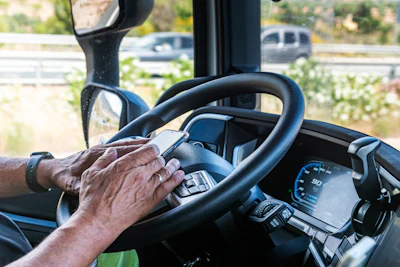
Cell phone distraction represents a huge and growing risk to logistics fleets. Federal government research estimates that 6.4% of drivers use a handheld or hands-free cell phone during any moment of the day. Meanwhile, a survey by the Insurance Institute for Highway Safety (IIHS) found that over 20% of drivers admitted to engaging in at least one smartphone-based distraction, such as messaging, video calling, watching content or using social media, on most or all journeys.
Commercial truck drivers, often working long hours, face greater temptation than most to handle a cell phone resulting from boredom, fatigue and isolation. However, stricter enforcement and professional training typically means lower violations rates, but when they do occur, the consequences can be far more severe due to the size of the vehicle and the greater stopping distances. At 60 mph, a truck needs approximately 525 feet to stop, compared to 240 feet for a car, so any delayed response can be catastrophic if there is a sudden slowing in traffic.
Most states have now passed some sort of statewide law against distracted driving and cellphone usage, which outlines when and how a driver can or cannot use a device behind the wheel. To date, over 30 states have banned handheld calls and texting for all drivers – with 20 specifically banning all drivers from holding electronic devices – while a further 17 states only ban texting. For truck fleets, FMCSA regulations also prohibit drivers from reaching for or holding mobile devices while driving, with violations potentially impacting CSA scores and DOT compliance ratings.
Fleets are also being urged to adopt clear, consistently enforced policy frameworks including strict prohibition on handheld cellphone use while driving. However, tougher laws and corporate policy alone will not be sufficient to change attitudes towards smartphone devices and tackle this dangerous behavior. Truck fleets will need to consider ongoing engagement, structured training, and clear communication of real-world consequences, underpinned by incident data and near-miss reporting. We will also see more fleets adopting emerging innovations, which are expected to become increasingly central to risk reduction.
Telematics has evolved in recent years to better target driver behavior and fleet risk, such as distracted driving, although this typically focuses on gaining insights after the incident and taking corrective action. Monitoring harsh driving events can effectively identify underlying issues, while driver-facing cameras can determine if a mobile device was in use during a near miss or collision. More recently, AI cameras identify and address distracted driving as it happens, however, there have been some concerns amongst drivers around privacy as well as the frequency of false positives, which can become an added distraction.
Emerging blocking technology – capable of preventing unauthorized access to smartphone apps and notifications while driving – is expected to be one of the next breakthrough technologies in the fight against mobile phone distraction. Using an app installed on a driver’s smartphone linked to a telematics unit or dashcam, the blocking technology restricts access to non-essential functions when the vehicle is in motion, without preventing legitimate work-related or emergency calls. This includes messaging apps, social media, streaming services, Internet browsing and camera use, as well as suppression of incoming notifications. A two-minute delay can also prevent drivers using their device when in stationary traffic to remove any impulse to illegally handle a cell phone and take eyes off the road.
Privacy concerns amongst drivers regarding in-cab monitoring technology are not uncommon, which can create a barrier for those fleets looking to take a zero-tolerance approach to illegal device usage. With this in mind, a mobile phone blocking solution offers a non-invasive alternative that can tackle the problem at root without the perceived intrusion on a driver while at work. It can also possess crash detection functionality, meaning a notification can be sent to verify if a collision has occurred and check on their welfare, which can be sold as an added benefit to the driver.
The welfare of drivers and other road users is a priority for all fleets, and yet, one of the biggest contributing factors to road collisions is all too often overlooked. There needs to be more done to remove the temptation for drivers to take their eyes off the road and discourage illegal device usage. By removing this distraction, fostering improved concentration and promoting a responsible driving attitude, it becomes possible to prevent many avoidable road injuries and deaths, while enhancing overall driver and fleet performance.