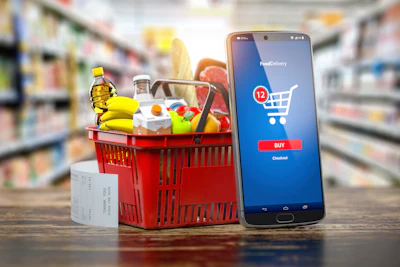
Online grocery shopping has experienced a surge in recent years, dramatically reshaping how Americans buy food. With U.S. online grocery sales exceeding $12 billion per month, shoppers now expect seamless omnichannel access to all goods and services. Whether it's in-store shopping, picking up curbside on the way home, or scheduling delivery to their doorstep, shoppers expect options. As a result, convenience is no longer a differentiator. It is the expectation.
The operational reality behind omnichannel
To truly support customers across every touchpoint, retailers must synchronize inventory, labor, and logistics across stores, distribution centers, and digital platforms in real time.
Every customer has different needs; a family that is placing a routine weekly stock-up order may opt for delivery, while another shopper may prefer to browse online but complete their purchase in store. For retailers, each of these examples activates a different pathway to fulfillment, with differing costs, timing, and labor implications.
Most existing fulfillment models were not built for this kind of customer variability. Manual in-store picking might work when online volume is low, but as orders increase, it can lead to congested aisles and more products being out of stock, and creates competition between in-store shoppers and pickers fulfilling online orders. What once felt manageable can quickly become a strain on store employees and ultimately result in unhappy customers.
Centralized distribution centers, on the other hand, present a different challenge. They are built for scale and excel at efficiently moving large volumes of product, typically at the pallet level, to replenish stores. However, because they are often not located close enough to population centers, they are not designed to support the fast, smaller basket orders that define today’s market.
These fulfillment issues require a more sophisticated architecture, one that blends centralized scale with localized speed and precision. In practice, that means integrating the strength of regional distribution centers with store level fulfillment capabilities, rather than forcing one model to compensate for the shortcomings of the other.
Automation as the engine of modern fulfillment
Warehouse automation allows retailers to have more control over an order’s journey from inventory to customer. To satisfy ever-changing customer needs without impacting margins, modern automation systems combine robotics, artificial intelligence, and real-time data to improve inventory flow and picking accuracy.
Many functions that once were manual, such as palletizing, are now automated, with some robotic systems increasing speeds by as much as 50% while cutting error rates by roughly 25%. Gains like these raise the bar for what strong performance looks like, with automation driving this blended model at scale.
There are three critical advantages to automation.
· Accuracy is improved: Grocery margins are thin, and substitution errors or missing items diminish both profitability and consumer trust. Automated picking systems reduce mistakes and improve visibility into existing stock levels, while also providing real-time insight into expiration dates. This data helps grocers streamline replenishment timelines, ultimately reducing food waste.
· Speed is increased: As shoppers have become accustomed to same-day, even same-hour service, the grocery industry has been under pressure to keep up. Implementing automation allows retailers to shorten fulfillment windows without piling on unsustainable labor costs.
· Consistency is created: An omnichannel network must be able to operate reliably at scale across hundreds or even thousands of locations. With automation comes standardized processes that can be easily replicated, measured, and refined, creating a predictable experience for the customers regardless of channel or fulfillment method.
However, automation is not about replacing the physical store. Physical locations remain a cornerstone in the grocery retail industry as shopping destinations, brand staples, and fulfillment hubs. Where the opportunity for improvement lies is in the way automation is deployed. When thoughtfully integrated, automation strengthens a retailer’s flow at every level.
The rise of micro-fulfillment
If automation powers the network at scale, micro fulfillment extends that capability closer to demand. These compact, automated facilities are either embedded within, or adjacent to, existing stores or strategically positioned nearby. Designed to process high-velocity online orders, they enable local fulfillment that traditional models were never built to support.
Micro-fulfillment has emerged as one of the fastest growing segments in retail automation, with the market expected to reach $26 billion by 2031. By distributing automated capacity across local markets, retailers can accelerate order turnaround and improve service delivery. Orders can quickly be picked from shared inventory. This reduces in-store picking, thus freeing associates to spend more time assisting shoppers face to face.
Micro-fulfillment also offers a more agile approach in an industry where demand can shift quickly. Grocery shopping habits shift with the seasons, and these facilities provide retailers with tighter control over capacity during those fluctuations, making it easier to scale up or down during periods of peak or reduced demand. Simultaneously, automation-powered micro fulfillment centers expand the total number of SKUs available to consumers by using space more efficiently than a traditional store, allowing retailers to offer a broader range of products than consumers might find stocked on their local store shelves.
Micro-fulfillment is not meant to be a stand-alone strategy though; it works best as a strategic layer within a larger regional distribution network. Together, these operations create a flexible system that can route orders in the most efficient and cost-effective way possible.
Where data becomes a growth driver
Physical automation alone is not enough. To operate fluidly across channels, retailers need real-time intelligence layered on top of their physical infrastructure. That means end-to-end visibility into inventory throughout the network, not just what is in stock, but where it is located, how quickly it can be accessed, and which channel it should serve.
These advanced platforms are capable of much more than just moving products; they are responsible for analyzing and refining decisions in real time, forecasting demand down to the individual SKU, and rebalancing inventory between locations.
Precision becomes even more critical with perishable items. Short shelf lives and fluctuating demand make it increasingly difficult to manage with manual systems. Data shows that retailers who adopt live inventory tracking systems have been able to minimize stockout rates by 80%, resulting in less spoilage, fewer markdowns, and stronger in-stock performance.
Delivering on the omnichannel promise
An effective omnichannel grocery strategy ensures that a shopper’s interaction feels effortless, regardless of how they choose to engage. Orders are accurate. Pickup windows are reliable and varied. Deliveries arrive on time, at a time that’s most convenient for the consumer. With intelligent automation, retailers are well-positioned to deliver exceptional omnichannel experiences and service a greater number of customers at a lower cost to the business. And with a more flexible fulfillment foundation in place, they also have the freedom to test new service models, whether that be rapid delivery or subscription programs. The retailers that come out ahead will be the ones who treat omnichannel as an operational imperative, not just as a buzzword.







![Top Tech Logo 2026 Vertical [color]](https://img.sdcexec.com/mindful/acbm/workspaces/default/uploads/2026/04/top-tech-logo-2026-vertical-color.mWl7RAiZmg.png?ar=16%3A9&auto=format%2Ccompress&bg=fff&dpr=2&fill-color=fff&fit=fill&h=135&q=70&w=240)


