Foodservice logistics companies are the critical middle link between manufacturers and suppliers in getting products in the hands of distributors and consumers. Managing the complex web of stakeholders and integrated systems is necessary to keep up with rising global supply chain demands. This complexity creates blind spots, making it difficult for logistics managers to efficiently monitor orders, routes and overall product movement that adheres to both food safety standards and compliance requirements.
The lack of visibility in logistics management is often caused by siloed workflows and teams. If fleet managers, dispatchers, warehouse managers, drivers and others are not in sync with real-time updates, the result is delivery delays, stock shortages, food waste and weakened trust among internal employees and external partners.
Today’s logistics companies can no longer rely on manual processes and historical knowledge to effectively run their business operations. With the rapid pace of innovation evolving the transportation industry, particularly with AI-enabled solutions, those who don’t prioritize technology capabilities and leverage data insights will fall behind.
Industry perspective
There’s currently an upswing of transportation companies growing their technology capabilities and understanding the value of connected systems.
Recent industry research shows four in 10 logistics companies are planning for a major digital investment in 2026, with forecasting and visibility noted as the top technology focus area for many companies next year.
The food and beverage industry is a core market, and the time-sensitive demands of delivery are an ongoing challenge. Same-day and next-day delivery is critical for meeting safety standards and inventory needs and delivering super service. Without an advanced routing software solution, it’s nearly impossible to maintain this lightning pace.
Impact of automated routing
Take for instance, a leading foodservice redistributor of frozen, refrigerated, dry, dairy and protein products looking to overhaul its routing planning and optimization solution. With 40-50 trucks moving daily in the mid-Atlantic and Northeastern region, the company needed better oversight and transparency into all activity.
On average, the company was routing over 100 individual orders on a daily basis, right up until the afternoon cutoff deadline, and exceeding up to 100 stops. Manually planning and routing the continuous influx of orders was not sustainable or a productive use of time for their team. The company was looking to streamline orders and workflows to gain better insights and free up dispatchers and warehouse managers to focus on other tasks.
For years, the redistributor was manually routing trips using publicly accessible Google Maps and laminated maps with sticky notes in their offices. The reliance on rudimentary tools and individual experiences was causing inefficiencies, wasted time, headaches and subpar results.
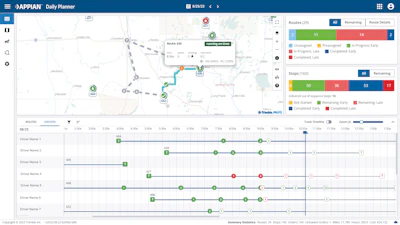
By implementing planning software, the company’s dispatchers now automate schedules and use dynamic routing to cover multi-route stops and other delivery nuisances. With a mix of frozen and cooler trucks and different vehicle sizes, the ability to customize navigation settings and factor in parameters such as delivery time windows, vehicle capacity and special equipment needs has improved the routing experience for both the internal team and customers alike.
Data insights point out gaps
While the transition may take a few months to adopt a new workflow, the end result is worth it, and unexpected opportunities typically unfold during the learning process.
One area that is often eye-opening for distribution companies is the influx of data insights to make process adjustments and improvements. For the Northeastern redistributor, the informative data has been a turning point in their business evolution, allowing them to compare routes day-over-day and week-over-week to identify where they are spending too much time or sending too many miles. The newfound insights have been crucial for maximizing fleet utilization, keeping costs down and recalibrating workloads.
Benefit of resource reallocation
While onboarding and training on a new software solution always takes extra upfront time, fleet management teams eventually gain significant hours back that allow them to reprioritize their workload. In the example above, dispatchers are now able to spend more time on compliance and other administrative tasks that were previously deprioritized due to the all-hands on routing management that now only takes one-third of the time previously needed.
End-game of scalability and a connected ecosystem
The benefit of implementing a flexible software solution for routing is the ability to scale the system up and down based on unique geographical and business needs at different locations.
Implementations usually start in headquarter markets to build a centralized system that can be a replicated model in other markets as a company’s footprint grows.
Now in the New Year, transportation companies with siloed, unorganized routing challenges should take an unbiased, critical look at both their existing internal processes and the technology systems supporting them.
A successful change or adaptation often requires change management and an open-minded, holistic approach to leveraging transportation technology platforms that can work as a connected, intelligent ecosystem to achieve greater supply chain visibility.