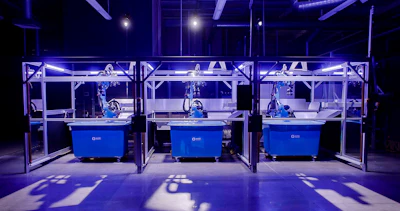
Ambi Robotics introduced AI Skill Suite powered by AmbiOS, production-proven 3D AI robot applications for licensing by trusted partners. This initiative allows Ambi’s operationally-validated AI to be deployed across a wide range of industries and third-party hardware use-cases.
“The hardest challenge in robotics is not demonstrating intelligence in a lab, but enabling robots to rapidly adapt to economically valuable work with industrial reliability,” says Jeff Mahler, co-founder and CTO of Ambi Robotics. “By deploying hundreds of robots into production environments, physical AI is trained, refined, and scaled through real-world operations. With AI Skill Suite, powered by AmbiOS, we’re making our production-hardened intelligence available in standardized applications that allow select partners to add perception, reasoning, and physical world manipulation to diverse robotic hardware configurations.”
Key takeaways:
· AmbiOS is the software stack that enables AI-powered systems to achieve industrial-grade reliability by connecting the brains and bodies of robots to critical infrastructure for support, safety, and customer operations.
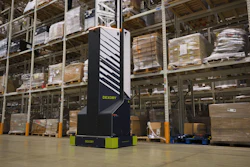
· By isolating hardware complexities, AmbiOS enables the AI Skill Suite to operate across varying robotic form factors and use-cases. This architecture creates a data-rich ecosystem where real-world interactions are used to refine underlying foundation models.
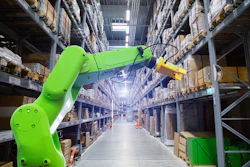
· The AI Skill Suite features a rapidly growing library of autonomous robot capabilities, including item intelligence, inspection, dexterous picking, and precision placement. These skills are powered by PRIME-1, the company’s vertically-integrated AI foundation model.
· By leveraging advanced 3D reasoning, PRIME-1 achieves superhuman performance with over 99.9% uptime. The model is trained on a massive repository of production telemetry, encompassing over 250,000 production hours and 150 million consumer packages processed across a nationwide fleet.