
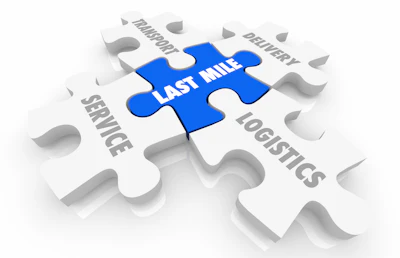
The last mile is approaching a breaking point. Delivery volumes continue to climb as retailers race to tighten delivery windows while expanding same‑day and even one‑hour options. At the same time, city streets are becoming more congested, sidewalks more crowded and urban areas more complex to navigate.
While many fleets meticulously plan how drivers move from the warehouse to the delivery address, these pressures are converging after they arrive and in the final moments of a delivery. It is no longer enough to get a driver to an address on time. What happens after arrival - finding legal & safe parking, navigating dense buildings, locating the correct entrance and completing the handoff - now determines delivery success and customer satisfaction.
This is the “last meter” of delivery, and it is where today’s efficiency gains are won or lost.
Why the last meter deserves its own strategy
The last mile - the shortest stretch of fulfillment – is also the costliest, making up 53% of total supply chain costs. Factor in the rising costs of fuel, vehicles and labor and it’s easy to see why.
For years, last mile optimization has been treated primarily as a routing problem with a remit to reduce drive time and improve ETA accuracy. All of that still matters, but it is no longer sufficient. In today’s dense urban communities, arriving at an address is not the same thing as completing a delivery.
The last meter is the hyper-local final leg of a journey, extending from arrival at an address to the final handoff. When fleets fail to manage this last stretch, drivers are forced to improvise. And improvisation is expensive, especially when it results in excess idling, increased service times, unsafe parking, failed delivery attempts and customer service escalations.
The repercussions are straightforward. Operations leaders who manage the last mile but ignore the last meter lose out on major efficiencies and cost savings.
The scene fleets know too well
Ask any driver what slows them down and you will hear variations of the same story: a driver arrives at an address only to find congested streets and no obvious place to safely park - constrained by loading rules, bike lanes, construction or too many vehicles competing for the same spaces. She circles the block looking for legal parking, then shifts from the last mile vehicle navigation to last meter problem-solving. Which side of the building is the correct entrance, which route is fastest and safest on foot, which door matches the delivery instructions, how to access a secure lobby and where the package can be left so the delivery is successfully completed?
This is the daily reality of modern delivery. Fleet managers can do everything right in planning, then lose precious minutes at the stop. It’s enough to disrupt sequencing and create ripple effects that force dispatchers to intervene and costs to compound over multiple routes and deliveries.
This is the hidden reason many fleets struggle to achieve consistent on-time performance. They are managing routes as if the destination is a point on a map; not a real-world environment with rules, constraints and ambiguity.
The data gap and AI opportunity
The last meter is plagued with poor, missing, confusing or inaccurate data. Delivery drivers and couriers are accustomed to issues like incomplete addressing, unclear building access, unmarked entrances and ambiguous handoff locations.
Closing the last meter gap requires a different mindset about location intelligence. It is not just navigation, but the ability to represent delivery reality at address-level and sub-address-level precision.
This is also a great use case for AI in logistics. The most effective approaches pair AI with automated observation and feedback loops that learn from real-world deliveries to establish operational ground truth. With the help of AI, fleets can treat the last meter as a measurable, improvable part of the system.
The goal is to minimize uncertainty: fewer unknowns at the curb, fewer surprises at the door, fewer outcomes dependent on who the driver is and how familiar they are with a territory. That consistency has become an operational necessity.
Urgency at the last meter
Macrotrends and rising pressures are converging at the last meter, and precision is one of few levers to help fleets absorb the impact.
Fuel price volatility is shaping supply chain strategy in 2026, turning every unnecessary minute of idling, circling or reattempted delivery into direct cost for fleet operators. Even small inefficiencies at the curb are magnified when repeated across hundreds or thousands of daily stops. Precision at the last meter is the most practical lever fleets have to limit fuel waste without sacrificing service.
In response to rising gas prices and advances in electric vehicle (EV) performance, some organizations are moving to electrify their fleets. EVs offer clear long‑term benefits, but they also introduce operational constraints around range, charging availability and route predictability. A few unexpected minutes lost at each stop can push EV routes closer to their range limits, forcing mid‑day adjustments, charging detours or missed deliveries. As fleet electrification trends continue, precision at the last meter will be essential to making operations scalable, sustainable and reliable.
Customer expectations add another layer of urgency. Consumers experience seamless, location‑aware technology every day, from real‑time ride‑hailing to 30-minute food delivery. As a result, tolerance for late or failed deliveries is dwindling. In that context, brands are judged not just based on historical delivery benchmarks, but what customers believe should be possible with today’s technology.
These converging pressures leave fleets with less slack than ever before. They cannot offset inefficiency with cheaper fuel, longer delivery windows or forgiving customers. The best way to respond is with greater efficiency in the last meter, where improvements translate immediately into cost control, reliability and customer trust.
How to win in the last meter
The good news is that meaningful gains in last meter performance are possible with a few practical shifts:
1. Treat the final handoff as a workflow, not a coordinate. Optimize each phase of the final leg: approach, park, walk, access, handoff, confirm.
2. Invest in precision, not just coverage. It’s no longer enough to have map coverage with an address point. Precision means reliable, handoff-relevant location context.
3. Shift from static plans to dynamic. Route planning is essential, but the operating environment is not static. Treat execution as a live system that adapts to changing conditions.
4. Update measurement for continuous improvement. Fleets often measure on-time delivery, but metrics like first-attempt success, dwell-time and stop-completion variability help pinpoint where last meter uncertainty is concentrated.
It is tempting to think of last meter friction as the cost of doing business in urban environments, dense cities and in tight time windows. It should not be. As one-hour expectations expand and fuel volatility pushes costs upward, the greatest returns will come from reducing failure and waste at the very end of the journey.
For fleet managers, delivery performance is not judged by speed alone. It’s about accuracy, completion and predictability. In practical terms, that means elevating last meter intelligence to the same level as routing, planning and navigation. It means investing in precision data, feedback loops and execution-aware workflows. It means treating the final handoff as the moment where strategy meets reality, because that is exactly what it is.








![Top Tech Logo 2026 Vertical [color]](https://img.sdcexec.com/mindful/acbm/workspaces/default/uploads/2026/04/top-tech-logo-2026-vertical-color.mWl7RAiZmg.png?ar=16%3A9&auto=format%2Ccompress&bg=fff&dpr=2&fill-color=fff&fit=fill&h=135&q=70&w=240)


