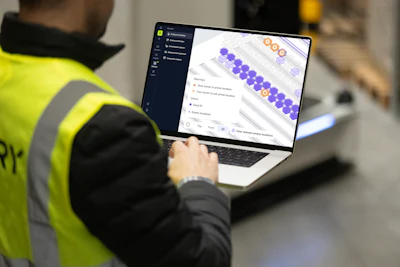
In many warehouses, uncertainty has become normalized. A pallet appears available in the system but cannot be found. Storage locations marked full are partially empty. Teams spend hours verifying inventory data that should already be accurate.
These problems rarely cause a complete operational failure. More often, they create a steady drain on labor, throughput, and capacity. In an environment where warehouse margins are already under pressure, that daily inefficiency becomes expensive.
Warehouse complexity has increased faster than traditional processes can keep pace. More SKUs, faster delivery windows, labor pressure, and constant movement across facilities all demand greater accuracy. Periodic counts and static reports often struggle to reflect what is happening in real time. As a result, teams end up reacting to problems instead of preventing them.
Why visibility is now a financial issue
Warehouse visibility is often framed as an operational priority, but it is increasingly a financial one. When managers do not trust stock location or space availability, they compensate in ways that add cost across the business. Some hold extra safety stock to reduce the risk of shortages. Others dedicate hours to manual searches, recounts, and reconciliations. Valuable storage capacity can sit underused simply because teams lack confidence in what is actually available.
Individually, these inefficiencies may seem manageable. Collectively, they can create a meaningful drag on performance. Research from Cornell University estimates that inaccurate inventory records alone cost retailers roughly 4% of annual sales, before factoring in added labor, avoidable write-offs, and delayed fulfillment. The issue is not always missing data. More often, it is data that arrives too late or cannot be trusted.
The operational burden of manual verification
When systems cannot provide a reliable picture of warehouse conditions, people are asked to fill the gap. That often means supervisors walking the floor to confirm stock positions, teams conducting time-consuming cycle counts, or staff investigating discrepancies that should have been identified earlier. These tasks may be necessary, but they pull labor away from higher-value work such as throughput improvement, quality control, and customer service.
Manual verification also introduces increased delays. By the time a discrepancy is found and resolved, downstream operations may already be affected. Orders can be held, pick routes disrupted, or replenishment decisions made using incomplete information. The real cost is often the time teams lose trying to investigate issues that should have been visible sooner. In a recent Forrester report, improved inventory visibility reduced missing pallet investigations from 24 hours to 30 minutes on average.
In practical terms, certainty creates capacity. When teams spend less time confirming basic facts, they gain more time to improve performance.
Turning real-time data into better decisions
The strongest warehouse operations are moving away from retrospective management and toward continuous decision-making. Rather than relying solely on scheduled counts or lagging reports, they use real-time operational data to understand what is changing as it happens. This can include inventory movement, location accuracy, congestion points, slot utilization, and emerging exceptions.
That shift matters because warehouse performance is highly dynamic. Conditions can change by the hour depending on inbound volume, staffing levels, or picking demand. Decisions based on yesterday’s data may already be outdated. When teams have access to live information, they can respond earlier. Misplaced stock can be corrected before it impacts fulfillment. Congested areas can be addressed before productivity drops. Space can be reallocated before bottlenecks develop.
This is where AI is becoming more useful. Not as a replacement for operators, but as a tool for processing large volumes of data, spotting patterns quickly, and surfacing actions worth attention. Human teams still provide judgment. Technology improves speed and accuracy.
Space utilization: the overlooked margin lever
Inventory accuracy often receives the most attention, but space utilization deserves equal focus. Warehouse capacity is expensive. Yet many facilities lose usable space through poor slotting, empty pallet positions, misplaced goods, or layouts that no longer reflect demand patterns. Without accurate visibility, these issues can persist for months.
The result may be unnecessary overflow storage, premature expansion planning, or reduced throughput in buildings that appear full but are not optimized. Organizations that improve slotting and space management can unlock measurable gains without increasing square footage. In one case, better visibility into available space saved 40 hours per week previously spent checking empty locations manually. In a high cost operating environment, making better use of existing space can be one of the fastest ways to improve returns.
Certainty as a competitive advantage
For organizations looking to reduce uncertainty, the first step is often straightforward: establish a reliable, accurate view of what is true today. This means understanding where inventory is, how space is being used, and where friction is developing.
From there, improvement becomes easier to prioritize. Teams can focus on root causes of delays, recurring errors, and wasted capacity rather than constantly reacting to symptoms. As supply chains become faster and more complex, certainty is no longer a nice-to-have. It is becoming a competitive advantage.
The real cost of uncertainty is not just the occasional missing pallet or delayed order. It is the daily accumulation of wasted time, avoidable expense, and missed opportunities to run smarter operations.