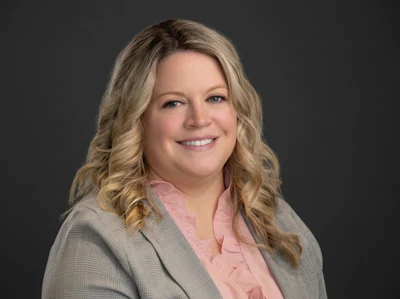
Shannon Curtis is the director of product marketing for The Raymond Corporation, a brand of Toyota Material Handling North America, where she bridges product planning and marketing to ensure the full commercialization of products and solutions.
Her role is part of a newer function built into Raymond’s business structure to provide greater support and alignment with customers evolving needs through product and solution innovation. She works holistically across departments and teams to ensure that products and solutions are designed and developed to fit customer needs.
Curtis began her journey with The Raymond Corporation in 2014 as a product manager for hand pallet trucks, then moved into the product marketing manager role for Class III and Class II trucks. She's played a pivotal role in product development and product commercialization for Raymond’s iWAREHOUSE Integrated Tether and the Raymond High Capacity Orderpicker, and helped introduce iWAREHOUSE ObjectSense & Notification System (iW.ObjectSense) and the Raymond 4260 Stand-up Counterbalanced Truck, underscoring Curtis' ability to help bring to market products and solutions that meet customers' needs.
In 2024, Curtis was named a Rock Star of the Supply Chain by Food Logistics and is a past recipient of the 2024 Women in Supply Chain™ Forum award.
Looking ahead, Curtis plans to continue bringing innovative products and solutions to market, and fostering collaboration across teams to ensure customer insights remain at the center of every step of product development.
Curtis was named a winner of this year’s Women in Supply Chain Forum™ award, presented by Food Logistics and Supply & Demand Chain Executive, in the Trailblazers category.
Marina Mayer, editor-in-chief of Food Logistics and Supply & Demand Chain Executive and co-founder of the Women in Supply Chain Forum™, sat down with Curtis to discuss customer-centric innovation, top industry trends and the importance of investing in educational programming to nurture talent early on.
Food Logistics and Supply & Demand Chain Executive: Your role as director of product marketing is to ensure that products and solutions are designed and developed to fit customer needs. What are some of the Top 3 trends you’re seeing customers need? And what do you attribute these trends to?
Shannon Curtis: One trend that we are seeing is that customers want to automate their operations. This doesn’t necessarily mean replacing their workforce, but rather, incorporating automation in the warehouse to ease burdens and make work easier for employees. For example, instead of humans doing all the heavy lifting, warehouses can incorporate autonomous mobile robots (AMRs) and automated guided vehicles (AGVs) to help move goods around in an efficient manner, ultimately meeting goals even faster.
Another trend we are witnessing is that warehouses are becoming interconnected ecosystem through smart software and data. Operators are becoming more reliant on telematics and intelligent fleet software to gather data on vehicle usage and overall performance of the fleet, empowering operations managers to make data-driven decisions in real-time. This helps operations remain connected and incorporate continuous improvements based on the data.
Another trend that has continued to rise over time is the adoption and implementation of sustainable power sources. Operations are continuing to make the switch from diesel-powered machines to electric forklifts that use advanced lithium-ion batteries. These energy sources boost warehouse efficiency by eliminating battery swapping and daily maintenance, offering faster charging and providing longer runtimes.
Food Logistics and Supply & Demand Chain Executive: You are a strong advocate for customer-centric innovation, acknowledging that technology is not a one-size-fits-all solution. Why is that?
Curtis I am a very strong advocate for customer-centric innovation and solutions as that has always been the philosophy at The Raymond Corporation. We believe that each and every one of our customers are on a unique journey to solve for their individual business challenges. No two customers are the same, which is why we believe in working closely with our customers to ensure that our solutions and offerings work for them and optimize their operations. Implementing new technology within operations can be costly, so we counsel our customers on ensuring they incorporate the solutions that fits them the best.
Food Logistics and Supply & Demand Chain Executive: You also played a pivotal role in product development and product commercialization for Raymond’s iWAREHOUSE Integrated Tether, the Raymond High Capacity Orderpicker, iWAREHOUSE ObjectSense & Notification System (iW.ObjectSense) and the Raymond 4260 Stand-up Counterbalanced Truck. Walk us through what each of these products are and how they’re meeting the needs of today’s supply chain customers.
Curtis; When developing new products and solutions to bring to market, we take a customer-first approach to create smart solutions that evolve with customer needs and can foster an ecosystem to connect, optimize and automate warehouses and distribution centers.
Raymond’s iWAREHOUSE Integrated Tether is the industry’s first integrated wireless solution. Designed to reinforce forklift operator training and best practices, the iWAREHOUSE Integrated Tether System limits truck operation if a proper connection is not detected between a self-retracting lanyard (SRL) and an operator’s harness. When a detection between SRL and operator harness is not detected, operators are detected by an audible alert, visual alert, and controlled slow down functionality.
The Raymond High Capacity Orderpicker is designed to facilitate order picking a full rack higher than models currently on the market. This first-of-its-kind lift truck delivers market-leading capacity at all heights and reduces annual cost per pallet stored by 19% compared with competitors. The new orderpicker features an industry-leading elevated height of 456 inches, which allows for increased rack storage access to 11% more pick slots. The increased elevated height enables operators to optimize storage capacity for more usable space and improved SKU count without increasing a facility’s overall footprint.
Raymond’s iWAREHOUSE ObjectSense & Notification System (iW.ObjectSense) serves as a notification system that can alert operators to obstructions while traveling in the tractor-first direction by using audible and visual alerts. The system also offers controlled slowdown and stopping functionalities, ensuring operators remain in full control of lift trucks at all times. iW.ObjectSense relies on a dynamic detection field that automatically adjusts alongside lift truck speeds, lengthening and shortening detection areas as needed for optimum performance and smoother deceleration in the event that an object has been identified.
The new Raymond 4260 Stand-up Counterbalanced Truck, with advanced performance, operator-focused design, and integrated intelligence, is a smart, scalable solution that evolves with business needs. With a 3,000- to 5,000-pound capacity, the Raymond 4260 delivers exceptional speed, acceleration and maneuverability with intuitive features that enhance comfort, control and confidence. Through advanced connected intelligence and technology, the Raymond 4260 enables operators, managers and lift trucks to work in sync. This stand-up counterbalanced truck offers a telematics-ready architecture that combines smart truck functionality, operator assist technologies and operational insights in the standard on-board display.
Food Logistics and Supply & Demand Chain Executive: Please share a difficult supply chain disruption you managed and how you turned the challenge into an opportunity.
Curtis: The supply chain and material handling industries continue to face many disruptions and challenges, which requires leaders to think quick on their feet and foster an even more connected network of key players. As customer demand increases, it is important for me to lead by example and encourage my team to remain strong and find ways to support our customers despite industry challenges.
Rather than getting deterred by industry challenges, my team and I took a proactive approach to work cross-functionally with other teams and partners to ensure we maintain frequent communication with all relevant stakeholders to provide transparency on lead times, recommend alternative solutions, and prioritize customer needs based on urgency.
By taking this customer-first approach with cross-functional planning and agile decision-making, we can fulfill customer needs, and ready to face new potential industry disruptions that may arise.
Food Logistics and Supply & Demand Chain Executive: What supply chain trend do you think will have the biggest impact over the next five years?
Curtis: Automation and artificial intelligence are continuing to gain momentum in the supply chain and material handling space. These technological advancements will have the biggest impact on this industry as a means to promote efficiency and productivity in warehouses and distribution centers; combat labor shortages by implementing automation and robotics to fill in labor and skill gaps, allowing employees to prioritize other tasks; leverage data as real-time visibility into warehouse and distribution center operations to inform decisions. The Raymond Corporation offers a suite of solutions rooted in automation and data that will move operations forward to meet business needs.
Food Logistics and Supply & Demand Chain Executive: What can organizations do to attract, retain, and develop women in supply chain roles?
Curtis: To attract, retain, and develop women in supply chain roles, organizations should invest in educational programming to nurture talent early on.
The Raymond Corporation runs a Youth Apprenticeship program for high school juniors and seniors based in the region. It provides hands-on career training in STEM (science, technology, engineering, and math) fields, connecting classroom learning with jobs in manufacturing, engineering, and business.
The Raymond Corporation’s University Research Program provides up to $500,000 in annual grants to North American universities. It invites professors and students to develop innovative solutions for the material handling industry in fields like automation, robotics, and advanced energy.
By investing in educational programming to target talent early on as they navigate their career prospects, organizations can shape their talent pipeline, ultimately shaping the talent of the industry.
Food Logistics and Supply & Demand Chain Executive: If you could go back in time and talk to your younger self, what would you say to her?
Curtis: I love this question because it's something I reflect on often. My career in product management wasn't one I originally planned, but it's become something I'm incredibly passionate about. Looking back, I'd tell my younger self to embrace every opportunity—even the unexpected ones—and not be afraid of the challenges that come with them. Every experience, whether it felt like a success or a setback at the time, taught me something that made me a better leader. Those lessons continue to shape how I approach new initiatives, develop teams, and navigate change today.
Food Logistics and Supply & Demand Chain Executive: If you could leave the audience with one piece of advice about being a woman in the supply chain, what would it be?
Curtis: It is important for women in the supply chain space to actively build a network of mentors. This industry has historically been male-dominated, and while strides have been made to elevate women in the field, women either entering the space or having been in the space should look to build a network of mentors. This will help build confidence, present opportunities, and foster professional development.
CLICK HERE to learn more about the winners from this year's Women in Supply Chain Forum™ Award.
CLICK HERE to register, sponsor and/or learn more about this year’s Women in Supply Chain Forum™, Nov. 17-19 in Charleston, S.C.