U.S. manufacturing activity expanded for the seventh consecutive month in July, with the sector growing at its strongest pace in over four years, according to the Institute for Supply Management. While this is overall good news, the continued growth and expansion could potentially further expose a growing issue some companies are experiencing between their production and storage.
As production lines become faster and more sophisticated, some manufacturers are discovering that their warehouses haven't kept pace. The result is a disconnect between production and storage that can create a host of issues, including inventory delays, inaccurate stock levels and production lines waiting for raw materials to come in or finished products to be removed. If left unchecked, these issues can reduce production efficiency, interrupt customer shipments and increase operating costs.
With the growing availability of modular, scalable warehouse automation technology, forward-thinking manufacturers are using this technology to bridge the gap by seamlessly connecting their production lines with their storage facilities. The warehouse essentially becomes an extension of the production line rather than a separate operation. The result is a more agile operation that reduces costs while providing greater responsiveness to changing customer demand and market conditions.
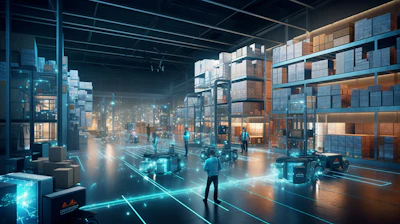
So, what might it look like when manufacturing processes and inventory management are connected through warehouse automation? While it can vary depending on a number of factors, it generally includes raw goods storage, automated transit to all manufacturing lines, automated transit back to finished goods warehouse, and distribution from the finished goods warehouse to semi-trucks.
The solution can include a variety of automation technology, including automated storage and retrieval systems (AS/RS), autonomous mobile robots (AMRs), automated pallet conveyors and stacker cranes. The entire system can also be orchestrated by an intelligent intralogistics platform that helps connect warehouse operations, automation, and processes in one unified system. This software platform provides the intelligence that turns a collection of automation technology into an efficient, resilient system.
Unlocking substantial benefits
Using automation solutions to bridge the gap between production and inventory provides a distinct advantage in production capabilities. It helps ensure manufacturing lines are running as efficiently as possible, especially when a ramp up in capacity is needed. Bolstered by continued advancements in warehouse technologies and software, once distinctly unique applications are now easily navigated as part of a wholistic automation strategy.
The following are benefits manufacturers of all sizes can realize from connecting production and storage with warehouse automation.
1. Increased throughput
Warehouse automation helps manufacturers significantly increase manufacturing reliability and output by removing manual bottlenecks and ensuring material and raw goods are always in the right place at the right time. This consistent and predictable flow of materials and products keeps manufacturing lines running without interruption, reducing changeover delays, preventing stockouts and eliminating idle time that often arises from manual handling.
By removing bottlenecks, manufacturers can achieve higher production rates without expanding their workforce. Automation also simplifies the compliance burden that some manufacturers, like those in the pharmaceutical, healthcare and food and beverage sectors, face by digitalizing and streamlining the process, which in turn, further eliminates bottlenecks.
2. Enhanced operational flexibility and scalability
Warehouse automation offers a blend of operational flexibility and scalability that enables manufacturers to adapt quickly as business needs evolve. One of the most significant advantages is its ability to maximize storage density. AS/RS technology allows storage to extend higher than what is typically feasible with manual operations. This can be as much as 150 feet compared to 40 feet in a traditional manual warehouse. By unlocking vertical space that would otherwise go unused, manufacturers achieve greater capacity without expanding a building’s footprint.
Warehouse automation solutions are often modular and configurable, designed as building blocks that can be incrementally added, removed or reconfigured as order volumes, inventory profiles or product lines change. This modulatory gives manufacturers the agility to evolve their facilities without major operational disruptions to support different processes, ongoing growth and continuous improvement. Manufacturers can begin by automating a single production line or storage area before expanding automation across additional operations. This scalable approach reduces implementation risk while allowing manufacturers to align capital investments with business growth.
3. Reduced errors and increased accuracy
Warehouse automation technology can dramatically improve accuracy and reduce errors in manufacturing beyond what is typically achievable with manual material handling. Human operators, despite training, can make mistakes due to fatigue, distraction or misinterpretation of instructions. Warehouse automation performs repetitive tasks with consistent precision and accuracy. The technology follows exact instructions every time, eliminating the variability inherent in manual handling.
For manufacturers like those in the pharmaceutical and food and beverage sectors, every touchpoint in the process carries contamination risk. Automation technology reduces the number of human touches and enforces controlled, enclosed handling processes. This not only prevents mix-ups but also helps maintain product quality, reducing the potential for human-borne contaminants or cross-contact.
4. Streamlined compliance and traceability
Many manufacturers operate under a strict regulatory framework that can include the Drug Supply Chain Security Act (DSCSA) and Good Manufacturing Practice (GMP) guidelines. Warehouse automation directly enhances compliance and traceability for sensitive products by unifying inventory control and real-time tracking across processes.
Advanced orchestration software provides automated enforcement of product tracking, enabling transparent, validated reporting for regulators and supply partners. This end-to-end traceability simplifies compliance and supports audit requirements for manufacturers like pharmaceutical and food and beverage operators. It turns compliance from a manual paperwork exercise into a byproduct of how the system already runs, ensuring product integrity and that recalls or investigations can be completed efficiently and accurately.
Planning for a successful deployment
Successfully connecting production and storage requires more than purchasing new automation equipment. Manufacturers should begin with a comprehensive evaluation of their existing material flow and long-term operational objectives. Several factors deserve careful consideration.
1. Manufacturers should understand where bottlenecks currently exist. Automation delivers the best ROI when it directly addresses measurable, operational challenges and objectives.
2. Scalability needs to be a primary consideration. Business conditions and objectives will inevitably change, so automation technology should accommodate future growth, additional production lines, new product introductions, and evolving customer requirements
3. Software integration is critical. Orchestration software provides the intelligence that turns a collection of automation technology into an efficient, agile system.
4. Facility layout plays an important role. Existing buildings can present opportunities and limitations, making early planning essential to maximize system performance while minimizing disruption during implementation.
5. Automation providers should be viewed as long-term partners rather than equipment suppliers. Successful projects require thoughtful system design, implementation expertise, employee training, ongoing service and future optimization as operational needs evolve.
As warehouse automation technologies become more modular, scalable and accessible, storage is no longer simply an upstream function disconnected from production. Instead, warehouse operations can become an integrated component of a synchronized manufacturing environment where materials flow seamlessly from inventory to production to customer.