The United States is projected to be short 1.1 million supply chain workers by 2035, and that shortage arrives at the exact moment AI is rewriting what those workers actually do.
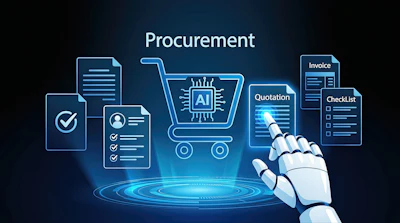
Agentic AI is absorbing the operational work that used to train procurement teams. Intake, supplier identification, RFx execution, bid collection, first-pass evaluation; software handles more of it every quarter. That work was repetitive and slow, but it was also how a generation of buyers learned the job.
Most procurement leaders started their careers the same way; started at the bottom, running RFQs and chasing quotes, and over time, saw how categories behaved, which suppliers delivered, and where deals went sideways. The grunt work was the training ground.
Now that operational layer runs with light human oversight. For throughput, that's a clear win. For talent, it creates a quieter problem that most organizations haven't started to address.
The career ladder loses its bottom rungs
When AI handles the operational work, junior buyers don't spend years doing it, which means they don't build judgment the slow way anymore. The strategic roles everyone wants to promote people into still demand that judgment - reading a supplier relationship, knowing when a price is too good to be true, sensing risk before it shows up in the data.
You can't skip the reps and expect the instinct. Procurement has long treated operational work as something to grind through on the way to strategy, so when you take the grind away, the development model built around it stops working.
This is already visible in how teams are structured. The best-run functions aren't hiring large pools of junior buyers to process volume; they're running leaner teams of higher performers who direct AI agents across far more spend than a manual team could ever touch. Fewer entry points, and higher expectations at each one.
The headcount fear misses the point
The common worry is that AI shrinks procurement teams, but the data says otherwise. Fairmarkit research found that 44% of procurement leaders expect their teams to grow as a result of AI adoption, and only 5% expect them to shrink.
So this isn't a story about fewer jobs. It's a story about different ones, reached faster - the work junior buyers inherit now is strategic from the start, even as the old on-ramp that used to prepare them for it disappears.
Strategic work now starts on Day 1
When agents handle execution, the work that's left is strategic. New hires who used to spend two years on RFQs can start on supplier strategy, category planning, and cross-functional partnership in their first month.
That compresses the career. A buyer three years in can operate with the reach of someone far more senior, because AI does the heavy lifting and they make the calls.
The skills that matter have shifted to match. According to the same Fairmarkit research, 82% of procurement leaders now rank data analysis and interpretation as the most critical capabilities for the job. Reading AI-generated output, spotting what's wrong with it, and applying judgment - that's the work now, and it's hard to learn without the operational foundation that used to teach it.
So the development question changes. It's no longer "how long until they're ready for strategic work," it's "how do we build the judgment that operational work used to build, without the operational work."
How to develop procurement talent when AI does the entry-level work
The teams getting ahead of this are being deliberate about it, and a few patterns are emerging.
The first is to rotate new hires through exceptions. When an AI agent escalates a decision, that's a teaching moment - a real supplier problem or trade-off, surfaced without the buyer having to run the whole event to reach it. Handled that way, exceptions become a curriculum.
The second is to pair people with agents early and make the reasoning visible. A buyer who reviews and overrides agent recommendations learns category dynamics faster than one who never sees them, and the audit trail behind each decision becomes a training tool rather than just a compliance record.
The third is to treat change management as a skill, not a memo. Directing AI agents, setting thresholds, and knowing when to intervene are learnable competencies, and teams that treat them that way onboard far faster than teams that assume people will simply figure it out.
The fourth is to give people room to experiment. Encourage your team to build with AI and agents on their own, even on projects that never ship. Whether or not anything comes of it, the tinkering demystifies the technology and opens people up to what's actually possible, and creative problem-solving becomes a force multiplier. This is where new hires have an edge. They come in with fresh eyes on processes everyone else has stopped questioning, and they're often the ones who'll rethink an old workflow from the bottom up with tech.
None of this happens on its own. The organizations that get it right will develop strategic talent faster than the old model ever did, and the ones that don't will end up with capable agents and a thin bench of people who can direct them.
Why workforce strategy is now the real differentiator
Every company in a given category will soon have access to the same class of AI agents, which means the technology itself will commoditize. How well a company pairs its people with that technology will not.
That makes workforce strategy a competitive question rather than an HR footnote. Which roles do you keep, and what do they actually do now? How do you build judgment when the traditional path to it is gone? How do you retain high performers who can suddenly see their own ceiling much earlier in their careers?
Retention deserves particular attention here. When a buyer reaches strategic work in year one instead of year five, they also reach the limits of a given role sooner, and companies that don't build new paths forward - broader scope, more categories, real ownership - will train excellent people only to watch them leave.
Procurement has spent a decade arguing it deserves a strategic seat at the table. AI is now handing the function of that seat by clearing away the operational work that kept it busy. Whether procurement can fill the seat depends on whether it can build the people who are ready for it.
The technology part is largely solved. The talent part is where the next few years will be decided.