Every major supply chain disruption eventually ends the same way.
A global manufacturer had everything on record, they just never put it together. A key supplier's payments had been slipping for two quarters, a material certification was weeks from expiry, and an insurance renewal had been missed — each signal sitting in a different system, visible to a different team, but no one connected the dots until a production line stopped.
In the meeting that followed, someone eventually asked the question everyone had been thinking: "How did we not see this coming?"
The uncomfortable answer is that, in many cases, the organization did see it. The information existed across systems of record, platforms, contracts and feeds - it just never got pieced together in time.
This is what's called the procurement risk gap: the time between the moment a meaningful risk becomes visible somewhere within the enterprise and the moment the organization takes coordinated action. Every company has one, and the difference between the resilient and the exposed is mostly how wide they let it grow.
The resilient companies haven't found a way to predict every disruption, but they’ve gotten better at closing the distance between noticing a risk and responding to it.
Procurement has spent years getting better at writing contracts. It's spent far less time on what happens in the days after, once a contract's assumptions quietly stop being true.
Decision latency: Procurement's invisible cost
Most procurement leaders can tell you their savings targets, their supplier performance scores and their contract compliance rates. Ask them how long it takes the organization to recognize a meaningful supplier risk and coordinate a response across procurement, legal, finance and operations, and most won't be able to answer.
That number has a name: decision latency, the elapsed time between when an organization knows something and when it acts on it. It might be the most important number in procurement that almost no one tracks
Disruptions don't usually get expensive the moment they happen. They get expensive over the time it takes an organization to figure out what to do about them. Gartner found that 89% of companies experienced a supplier risk event in the past five years, and nearly two-thirds were delayed in responding because they lacked a framework to continuously predict, assess and manage sourcing risk.
Procurement was built for a world that moved at a different pace, a world where supplier performance was reviewed periodically, compliance was validated on scheduled cycles, and risks usually developed slowly enough for governance to keep up. That world no longer exists.
A geopolitical event can change sourcing decisions overnight and a tariff change can restructure the economics of a critical supply market before the next quarterly review even happens. When either hits, the question isn't whether procurement has the right framework on paper, it's how long it takes to identify which contracts are exposed, figure out what alternatives exist, understand renegotiation rights, and get a response coordinated before the cost hits the P&L.
Macro shocks don't create the vulnerability, they expose the ones that were already there.
What AI fixes: Procurement resilience
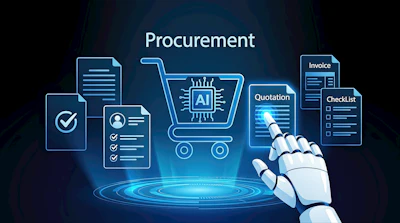
The decision latency gap closes when an organization can see risk forming across disconnected systems and act before the window to respond closes. Earlier generations of technology stored that risk and displayed it on a dashboard, but none of them connected it. AI does — it senses risk across systems and acts on it directly.
Three capabilities make this possible. Most organizations have a few pieces of each, but few have all three working together:
First, it works continuously in the background instead of waiting for someone to ask. When an invoice arrives, it gets processed. When a certification is nearing expiry, the system raises a flag. When a renewal deadline approaches, it triggers the next action automatically. The point is that none of these tasks depend on someone noticing them at the right moment. Anything that relies on a person remembering to start the process can be missed, delayed, or pushed aside. Remove that dependency, and issues are identified as they emerge rather than months later when someone finally pulls a report.
Second, it handles problems that do not follow a fixed script. A supplier dispute, a regulatory exception, a multi-party onboarding: none of these arrive with a predetermined resolution path. Automating a known process was never the hard part. The harder work is pulling the right people, data and decisions around an unstructured problem before it compounds.
Third, it activates data the organization already owns but rarely uses. Every ERP, procurement platform and finance system holds years of transactional history: supplier payment behavior, compliance records, purchase patterns, past risk events. Few companies suffer from too little data. What they lack is the ability to turn that history into a warning before it becomes a loss.
Miss any one of these and the gap stays open. Get all three right and procurement moves from responding to disruption to building resilience into everyday operations.
The next competitive advantage
More supplier audits, tighter governance and better procurement software will remain worthwhile investments. But each one makes the organization a little smarter without necessarily making it any faster.
Resilience is not just about having the right processes. It is about how quickly an organization can activate them when it matters. The organizations that build it will close the gap between recognizing risk and acting on it, and they will measure decision latency as seriously as they now measure contract compliance.
Most organizations already have what they need. AI is what allows them to use it differently - not simply as a productivity tool, but as the connective layer that brings together signals that have long been scattered across different systems. The intelligence already exists in contracts, ERP systems, and supplier and compliance records. Access has never been the constraint. The challenge has been turning that information into action.
Two companies can face the same market conditions, work with similar suppliers, and have access to comparable data, yet still end up in very different places. The difference isn't what they knew - it's how quickly they acted on it. The companies that get there first won't see procurement as a function that supports the business. They'll see it as one that steers it.