Egham, UK — September 3, 2009 — Organizations are at risk of three major pitfalls as they strive to achieve an efficient and effective "multisourcing" environment as part of their outsourcing efforts, and CIOs and sourcing managers need to develop specific competencies to master multisourcing, according to a new report from research firm Gartner.
Multisourcing, according to Wikipedia, "is the disciplined provisioning and blending of business and information technology services from the optimal set of internal and external providers in the pursuit of business goals. It is also defined as a strategy that treats a given function, such as IT, as a portfolio of activities, some of which should be outsourced and others of which should be performed by internal staff." Wikipedia credits Gartner with coming up with the term "multisourcing" in 2005.
A recent Gartner benchmark study found that 55 percent of global organizations manage their sourcing activities tactically and at an operational level, failing to add a strategic management layer or to invest enough in developing critical multisourcing competencies, according to Frank Ridder, research director at Gartner.
"Many organizations struggle to develop an effective and efficient sourcing environment, which is necessary to achieve positive sourcing outcomes," Ridder said. Gartner predicts that through 2012, inflexibility caused by an excessive cost reduction focus will result in business disruption in 30 percent of outsourcing deals, including the inability of the buyer to compete effectively.
Key Challenges
The three key challenges that organizations face in multisourcing include:
Outsourcing Deals Are Difficult to Build and Manage — Outsourcing deals are difficult to manage for four main reasons. First, many organizations lack the experience to properly oversee and estimate the end-to-end effort that outsourcing requires. Second, a project team often centrally plans and executes sourcing projects amid emotionally charged political agendas. Third, new options, such as alternative delivery and acquisition models, change the way the sourcing lifecycle drives activities and increases the complexity of the sourcing environment and the decision-making process. Finally, the service provider landscape is dynamic, which makes it frequently challenging to find the right one with which to build a long-lasting relationship.
Outsourcing Deals Often Fail to Deliver Expected Outcomes — Once an organization has established an outsourcing relationship, it often faces further difficulties because an outsourcing relationship frequently promises more than it delivers. Some challenges can arise, such as low end-user satisfaction, poorly defined business benefits and immeasurable deal benefits, complex governance and strained relationships.
Outsourcing Deals Often Fail to Evolve — Organizations are frequently disappointed because their outsourcing contracts failed to deliver the innovation they had anticipated. In addition, outsourcing deals often aren't structured to provide the flexibility needed to enable the deal to adapt quickly to changes in the market and organization. They don't always evolve due to factors on the client side (organizations often fail to describe what evolution and innovation mean to them) and the service provider side (changes may disrupt their businesses and jeopardize their margins).
Organizations can manage these challenges by building a successful, outcome-oriented sourcing environment, Gartner suggests. The research firm has identified 10 key competencies to help organizations move toward efficient and effective multisourcing.
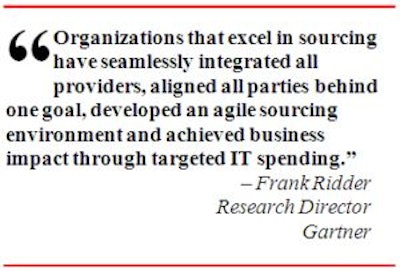
"Organizations that excel in sourcing have seamlessly integrated all providers, aligned all parties behind one goal, developed an agile sourcing environment and achieved business impact through targeted IT spending," Ridder said. "Others who lack the right competencies are more likely to experience sourcing inefficiencies caused by misalignment, idle resources, unnecessary processes, overloaded operations, a heavy inventory or a lack of focus."
Additional information is available in the Gartner report "Understand How to Overcome the Three Pitfalls of Multisourcing," which is available to Gartner clients or for purchase at the firm's Web site at www.gartner.com/DisplayDocument?ref=g_search&id=1032512&subref=simplesearch.
Multisourcing, according to Wikipedia, "is the disciplined provisioning and blending of business and information technology services from the optimal set of internal and external providers in the pursuit of business goals. It is also defined as a strategy that treats a given function, such as IT, as a portfolio of activities, some of which should be outsourced and others of which should be performed by internal staff." Wikipedia credits Gartner with coming up with the term "multisourcing" in 2005.
A recent Gartner benchmark study found that 55 percent of global organizations manage their sourcing activities tactically and at an operational level, failing to add a strategic management layer or to invest enough in developing critical multisourcing competencies, according to Frank Ridder, research director at Gartner.
"Many organizations struggle to develop an effective and efficient sourcing environment, which is necessary to achieve positive sourcing outcomes," Ridder said. Gartner predicts that through 2012, inflexibility caused by an excessive cost reduction focus will result in business disruption in 30 percent of outsourcing deals, including the inability of the buyer to compete effectively.
Key Challenges
The three key challenges that organizations face in multisourcing include:
Outsourcing Deals Are Difficult to Build and Manage — Outsourcing deals are difficult to manage for four main reasons. First, many organizations lack the experience to properly oversee and estimate the end-to-end effort that outsourcing requires. Second, a project team often centrally plans and executes sourcing projects amid emotionally charged political agendas. Third, new options, such as alternative delivery and acquisition models, change the way the sourcing lifecycle drives activities and increases the complexity of the sourcing environment and the decision-making process. Finally, the service provider landscape is dynamic, which makes it frequently challenging to find the right one with which to build a long-lasting relationship.
Outsourcing Deals Often Fail to Deliver Expected Outcomes — Once an organization has established an outsourcing relationship, it often faces further difficulties because an outsourcing relationship frequently promises more than it delivers. Some challenges can arise, such as low end-user satisfaction, poorly defined business benefits and immeasurable deal benefits, complex governance and strained relationships.
Outsourcing Deals Often Fail to Evolve — Organizations are frequently disappointed because their outsourcing contracts failed to deliver the innovation they had anticipated. In addition, outsourcing deals often aren't structured to provide the flexibility needed to enable the deal to adapt quickly to changes in the market and organization. They don't always evolve due to factors on the client side (organizations often fail to describe what evolution and innovation mean to them) and the service provider side (changes may disrupt their businesses and jeopardize their margins).
Organizations can manage these challenges by building a successful, outcome-oriented sourcing environment, Gartner suggests. The research firm has identified 10 key competencies to help organizations move toward efficient and effective multisourcing.
- Strategy management: It aligns sourcing actions with the business goals, strategy, frameworks and governance to ensure optimal ongoing business support.
- Risk management: It prevents, detects and mitigates sourcing risks to substantially reduce the levels of risk across all deals.
- Financial management: It formulates financial targets with the business (for example, reduce total cost of sourcing, or TCS, by 15 percent in two years) to establish a clear guideline for all sourcing activities.
- Demand management: It oversees and prioritizes IT services based on demand to optimize resources and skills across all sourcing activities.
- Service management: It aligns the services across internal and external service providers (ESPs) to achieve seamless, end-to-end service delivery.
- Program management: It aligns portfolio and sourcing strategies so that projects achieve desired outcomes.
- Relationship management: It maintains the relationships with all internal and external service providers (SPs). It sets performance expectations with SPs, collects performance metrics for each and provides feedback.
- HR management: It helps to forecast and fulfill staffing needs relative to sourcing needs to ensure an optimal level of skills and resources.
- Performance management: It helps to optimize ESPs' costs and ensure that new or revised business goals are always attained.
- Contract management: It manages the contracting process to meet the organization's needs. It includes keeping internal contracts and industry best practice contract templates for future use.
"Organizations that excel in sourcing have seamlessly integrated all providers, aligned all parties behind one goal, developed an agile sourcing environment and achieved business impact through targeted IT spending," Ridder said. "Others who lack the right competencies are more likely to experience sourcing inefficiencies caused by misalignment, idle resources, unnecessary processes, overloaded operations, a heavy inventory or a lack of focus."
Additional information is available in the Gartner report "Understand How to Overcome the Three Pitfalls of Multisourcing," which is available to Gartner clients or for purchase at the firm's Web site at www.gartner.com/DisplayDocument?ref=g_search&id=1032512&subref=simplesearch.