Warehouse automation requires a trusted data foundation that unifies IoT streams, operational systems, and historical data through streaming architecture, open formats, and edge-to-AI deployment to enable real-time, coordinated decision-making across equipment and workflows.
- 92% of warehouse leaders consider automation essential for competitiveness, yet only 37% have significant automation deployed, with data integration as a major challenge
- IoT streaming architecture processes equipment telemetry in real-time to enable predictive maintenance and early warning systems before operational impact
- Unified data lakes using open formats normalize data from warehouse management systems, IoT streams, and enterprise platforms for consistent AI and ML analysis
- Edge-to-AI architecture deploys AI inference locally to reduce latency, eliminate cloud dependency risks, and lower total cost of ownership for critical warehouse decisions
- Proper governance ensures data quality, lineage, ownership, and model auditability to support transparent, explainable automation decisions
Warehouse operations leaders are being asked to move orders faster, expand fulfillment expectations, increase equipment availability, and manage workforce constraints, automation is critical to their success.
The imperative and interest in automation is clear, but adoption at scale remains uneven. A 2025 State of the Market report found that 92% consider automation essential for long-term competitiveness, while only 37% reported having significant automation in place. One major execution challenge the survey identified was selecting, integrating, and scaling automation.
For warehouses that depend on many systems and types of equipment, a trusted data foundation is a critical part of addressing that challenge. The quality, availability and accessibility of organizational data is critical for automation.
Harnessing IoT data
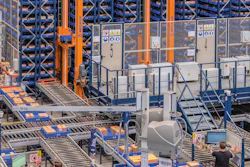
Connected machines produce a steady stream of operational data: motor temperature and vibration, conveyor status, scanner events, fault codes, and more. These signals can support predictive maintenance, help identify bottlenecks, and give teams earlier warnings when equipment or workflows are drifting away from normal operations.
The challenge is finding useful signals in what is often a constant stream of device telemetry. Operations teams cannot manually inspect every event and still respond quickly when something changes. A streaming architecture can process data as it arrives, filter or aggregate routine events, and surface the conditions that need attention. Teams can retain the data needed for trend analysis and investigation while moving the most relevant events into operational workflows.
That system gives maintenance and operations teams the chance to investigate unusual patterns before they impact operations or the customer experience. The value comes from making data available while it can still inform a decision, rather than looking at telemetry from a historical context after an incident occurs.
Unify warehouse data
Device telemetry rarely tells the entire story on its own. In order to build automated systems that can make accurate and consistent decisions, AI and ML models need to analyze telemetry in tandem with additional data streams and historical context sitting in static systems. The data that can provide that context often sits in disparate systems that were never intended to interoperate, including warehouse management and execution platforms, warehouse control systems, enterprise resource planning platforms, maintenance applications, equipment manuals, robotics software, and IoT streams.
A warehouse data lake built on open formats can make information from those sources available to different analytics and AI tools without forcing every team to use a single engine. Open formats improve portability, and a shared vocabulary or ontology can help normalize common concepts so different teams and models can speak the same language, and everyone can work from a more consistent view of the overall operation.
Governance supports the foundation by making data quality, ownership, lineage, and access easier to manage. Those controls help teams understand where information came from, who can use it, and how it changed. They also support model auditability and explainability, so teams can see and understand why AI made specific decisions.
The flexibility of the warehouse data lake extends to tool and model selection, as well. Many warehouse processes are deterministic, and using a probabilistic large language model (LLM) can lead to poorer outcomes and wasted money, whereas a traditional machine learning algorithm can support rules-based workloads more efficiently. LLMs can support knowledge work such as summarizing work orders or acting as a knowledge base for employees to ask questions in natural language. Every use case should be supported by the mode and model that is best suited for the work.
Bring AI to the data
Some warehouse decisions need to happen quickly and locally. If every inference depends on sending data to a remote cloud service and waiting for a response, then latency and lost or degraded network connections can affect the workflow. Critical local processes should be designed to keep working when cloud connectivity is unavailable.
An edge-to-AI architecture brings AI to the data. Teams can develop and train models using operational history and current data, then deploy the appropriate models to local infrastructure for inference. Models can evaluate fresh equipment or workflow data as close to the source as possible and return results without traveling to and from the cloud.
A hybrid design can leverage the right infrastructure for each part of the AI lifecycle: AI inference running continuously on local hardware the manufacturer owns is often cheaper than cloud inference, whereas intermittent model training in the cloud can take advantage of burst capacity. This architecture can result in a lower total cost of ownership, while also mitigating the risk of inference being unavailable due to a network fault and reducing latency.
Build automation on a foundation of trusted data
Warehouse automation depends on more than just connected equipment. Telemetry has to be processed in time to matter, operational data has to be normalized across systems and use cases, and AI decisions have to be fault-tolerant. A streaming architecture, an open and interoperable hybrid data foundation, and an edge-to-AI architecture that delivers AI decisions at the point where teams can take action can help warehouses move from isolated automation projects towards more coordinated, automated, and eventually lights-out operations.