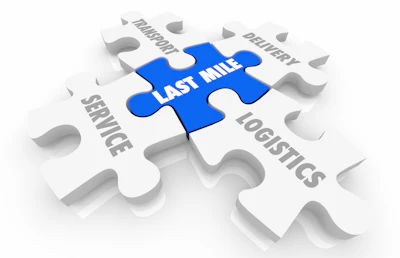
Last-mile transportation is where supply chain problems become visible.
Missed delivery windows, rising accessorial charges, carrier escalations, and service failures often surface during final-mile execution. When that happens, the response is predictable. Transportation teams review carrier performance, revisit SLAs, and look for short-term fixes to recover service.
Execution matters. But in many cases, last-mile performance issues are not execution failures. They are the downstream result of decisions made well before a shipment ever reaches a truck.
In fact, last-mile teams are often asked to solve problems that were already locked in upstream. By the time freight reaches last-mile execution, most meaningful decisions have already been made.
Where last-mile problems become visible
When service breaks down at the last mile, it feels logical to focus on the point of failure. That is where delays occur and costs spike. It is also where customers feel the impact most directly.
The issue is that last-mile execution operates within constraints it did not create. Transportation teams inherit volume profiles, delivery windows, order timing, and service expectations set earlier in the planning process. Once those inputs are finalized, the range of viable transportation options narrows quickly.
Last-mile performance is often evaluated in isolation. In reality, it reflects the quality and timing of upstream decisions.
Last-mile execution is where problems surface, not where they start.
How upstream decisions shape last-mile outcomes
Demand signals are among the earliest drivers of last-mile performance. Forecast accuracy matters, but timing matters just as much.
When demand changes arrive late in the cycle, transportation teams are forced into reactive mode. Volume commitments shift with limited notice, leaving little opportunity to secure cost-effective capacity or optimize routes. Planned moves become fragmented shipments. Standard modes give way to premium options.
Order timing compounds the issue. Late order releases compress execution windows. Cutoff times are missed. Consolidation opportunities disappear. Transportation teams are left with fewer routing options and tighter delivery promises to meet.
This pattern is especially visible during new customer onboarding.
In many organizations, commercial teams finalize service commitments, delivery windows, and order profiles before transportation is involved. Once the customer is signed, transportation is asked to match the requirements rather than help shape them. By that point, expectations are already locked in.
Delivery promises, order cadence, and volume assumptions are treated as fixed inputs, even when they introduce unnecessary cost or execution risk. Transportation teams are left to solve for constraints they had no role in defining. What later appears as a last-mile execution challenge often starts as an onboarding decision made without transportation insight.
From a transportation perspective, volatility itself is not the problem. The problem is volatility introduced too late to manage.
Last-mile cost and service outcomes depend heavily on how early volume expectations stabilize and how disciplined order release becomes. When transportation receives critical inputs after planning decisions are already set, execution turns into a series of compromises rather than deliberate choices.
When critical inputs arrive late, transportation choices narrow quickly.
When planning cadence and transportation reality collide
Planning cadence also plays a significant role in last-mile performance.
Many organizations plan weekly or monthly, while transportation executes daily. When planning updates lag execution realities, transportation becomes the buffer. Sudden volume swings, priority changes, and last-minute exceptions all flow downstream.
This mismatch turns last-mile operations into a shock absorber. Transportation teams absorb variability that planning cycles cannot address quickly enough. Over time, this leads to constant firefighting. Not because transportation lacks discipline, but because it operates without stable inputs.
As decisions arrive later and variability increases, last-mile execution options shrink. Mode selection becomes constrained. Capacity tightens. Costs rise as premium services replace planned moves. Service commitments become harder to keep, regardless of carrier performance.
What often gets labeled as an execution problem is, in reality, the outcome of upstream decision timing.
Transportation becomes reactive when planning cadence cannot keep pace with execution.
Designing last-mile performance earlier
Improving last-mile performance starts earlier than most organizations expect.
Leaders should treat last-mile outcomes as something to be designed, not managed after the fact. That requires greater attention to when decisions are made, not just what decisions are made.
Stabilizing demand signals earlier, enforcing clearer order release discipline, and tightening handoffs between planning and transportation can materially improve cost and service outcomes. These changes do not require new tools or large programs. They require clearer decision ownership and better synchronization.
Transportation performs best when it operates within a system designed for execution, not exception handling. Last-mile transportation is where supply chain decisions become visible. It is not where most problems originate.
When organizations shift their focus upstream and address decision timing, last-mile execution becomes more stable, predictable, and cost-effective. Transportation teams spend less time firefighting and more time delivering consistent results.
In many cases, improving last-mile performance is less about changing how trucks run and more about changing when decisions are made.
Stable last-mile performance depends more on decision timing than execution effort.