While flexibility and agility have always been best practices for business continuity, recent times have shifted those traits to non-negotiable requirements. The latest wave of disruption may not quite reach peak pandemic-level challenges, but many of the learnings from COVID-19 have undoubtedly reshaped how manufacturers are thinking about resilience. In the wake of tariff uncertainty, global conflicts, and factory contraction, organizations are pulling familiar pages from familiar playbooks.
Recent research finds that companies are abandoning just-in-time supply chains and stockpiling instead: 54% of businesses have increased on-hand inventory of international goods to hedge against tariffs. This strategy is highest in aerospace (64%) and large enterprises (57%), reflecting a shift in risk management.
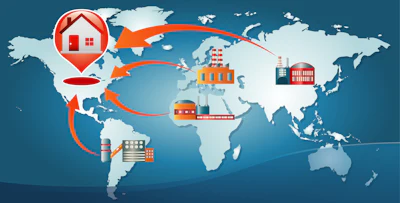
In addition to stockpiling; nearshoring and diversification have also come back into focus. The same report indicates that companies are reshaping sourcing, trade models, and payment strategies to sidestep tariffs: 50% are increasing domestic sourcing, led by 62% in automotive and 55% in manufacturing, while 43% are leveraging free trade zones to reduce tariff exposure.
These traditional strategies reflect a response to a turbulent market. However, reactive by nature, these tactics are no longer enough on their own. When facing a challenge without foresight, such as tariffs, businesses risk overstocking the wrong materials, misaligning timing when shifting sourcing, and making key decisions based on old assumptions.
Strategies like stockpiling and nearshoring can both help or harm margins, entirely dependent on how and when they are implemented. As turbulence continues, successful businesses are making smarter execution decisions that are informed by real-time data, predictive analytics, and AI.
Intelligence at the core of strategy
With the rise of real-time analytics and decision-making, organizations are continually becoming better positioned to use predictive modeling to their advantage. Now, businesses can prepare for abrupt changes such as tariffs, supply shocks, and demand surges before they take effect by modeling outcomes. Imagine if a business could predict how a tariff would impact everything from cost to inventory. Or if they could determine which suppliers are most vulnerable under different scenarios? The additional layer of knowledge provided by this intelligence directly translates to more informed decision-making.
By using real-time analytics, businesses gain visibility into current supply, demand, and cost conditions. Predictive modeling allows organizations to evaluate outcomes before the disruption happens. Using this intelligence, businesses gain a comprehensive view of present and future market conditions, enabling them to make the best possible decisions. This turns reactive and defensive actions into data-informed advantages.
The AI adoption gap
That said, the capabilities of AI are being vastly underutilized in the industry. Companies have become proficient at adapting to volatility: 79% of businesses have adjusted to tariffs, either by planning ahead (39%) or reacting quickly (36%). Yet, AI adoption remains low. Fewer than 40% use AI for trade decision-making, and only 34% leverage predictive analytics – leaving these areas ripe for robust growth.
Organizations are demonstrably adapting to market turbulence. Yet, they’re doing so without foresight. Decision-making is largely informed by manual analysis and precedent, rather than large-scale data-backed insights. This creates a gap between reactive changes and proactive strategy, highlighting a crucial unrealized opportunity for businesses.
Adaptation to anticipation
As proactivity increasingly becomes a competitive advantage, AI’s edge lies in improving reaction accuracy and efficiency.
Take any sport, for example. Successful teams have set plays to respond to specific, high-impact scenarios that might happen in a game, thoroughly practiced and perfected. For a successful business, the concept remains the same. AI allows businesses to implement scenario planning for anything from tariff changes to supply disruptions and demand fluctuations – effectively creating “plays” for potential scenarios. With proper planning, manufacturers can meet challenges with confidence, having already simulated impact and compared options. Thus, when faced with disruption, organizations not only know what to do, but also how to do it.
Manufacturers that have embedded intelligence across their operations are those best equipped to benefit from scenario planning and simulating the impacts of policy changes. At the end of the day, those best prepared will be able to make confident decisions before challenges escalate. In today’s environment, avoiding disruption isn’t the right target, outmaneuvering it is. Companies that embed intelligence into their decision-making will not only protect themselves against market challenges, they will thrive in the face of them.
Moving with the market
Organizations shouldn’t be hyper-focused on using or discarding traditional strategies, but rather on refining them. What’s changed is the context: global complexity, regulatory pressure, and demand volatility now require a higher level of execution. Resilience today isn’t just about having options; it’s about knowing which option to act on and doing so with speed and confidence.
The organizations pulling ahead are those treating data not as a passive resource, but as an active enabler of smarter decisions. With trusted data foundations, embedded analytics, and the strategic use of AI, manufacturers can shift from reacting to uncertainty to outmaneuvering it. In a world where disruption is constant, adaptability isn’t enough. Precision, powered by insight, is what sets leaders apart.