Walt George helps American-Italian Pasta Co. move a billion pounds of pasta through its supply chain every year. Here's how.
[From iSource Business, August/September 2003] Americans consumed about 4 billion pounds of pasta in 2002, and just one company produced about a quarter of that total. American-Italian Pasta Co. (AIPC), based in Kansas City, Mo., had sales of $381 million in 2002, and yet the company employs just 630 people and operates five production facilities, including four in the United States (in Excelsior Springs, Mo.; Columbia, S.C.; Kenosha, Wisc.; and Tolleson, Ariz.) and one abroad (Verolanuova, Italy).
One billion pounds of pasta, placed end-to-end in 16-ounce packages of spaghetti, would stretch around the Earth's Equator nearly nine times, so you can imagine the supply chain necessary to get all the ingredients into the plants and all the packaged goods onto store shelves in an orderly — and moreover, low-cost — fashion. The responsibility for running AIPC's supply chain falls to Walter N. George, executive vice president of operations and supply chain at the company.
Prior to joining AIPC in January 2001, George completed a 12-year career as vice president of supply chain for Colgate-Palmolive's pet food subsidiary, Hill's Pet Nutrition, where he was a member of the parent company's global logistics council. George began his career with Frito-Lay, and his experience ranges from plant management, inventory planning and management, sales and operations to customer service, logistics and strategic planning.
George recently spoke with iSource Business about AIPC's supply chain, the importance of technology to driving efficiencies in that supply chain, and how his function contributes to the company's overall competitiveness. But first we asked George to talk about his role at AIPC.
George: My role in the organization is to provide strategic oversight and direction for the supply chain that begins with our flour milling operation and extends literally all the way to our customers' shelves. We have a fully integrated supply chain and manufacturing organization. A lot of companies break those things apart: What they call "supply chain" begins at the manufacturing dock and is really more logistics. That's not the case here. We are fully integrated, and supply chain includes customer service, the strategic planning group, forecasting and demand planning. We also have an extensive supply chain modeling capability that we developed when I joined the company.
iSource: What are you typically sourcing?
George: Obviously, our biggest material sourcing is durum wheat, and that plays a key role in a lot of our supply chain planning. The greatest source of wheat for us comes out of the Dakotas — out of North Dakota primarily — and also out of the desert in Arizona. Historically, we've sourced a lot of wheat out of Canada — Saskatchewan, Manitoba, really up in the North American wheat belt.
We bring that wheat in by train to our facilities in Excelsior Springs, Mo., and Columbia, S.C., where we actually employ our own milling operations. We're the only vertically integrated pasta producer in North America to that degree — we mill all our own durum on both those sites.
iSource: What are the principal supply chain challenges you are facing today, and what processes and technologies are you implementing to meet those challenges?
George: The place to start is to talk about the supply chain philosophically. The approach that I've developed through my career is a little bit of a twist from what I think most supply chain managers would use. I would say that the supply chain begins with the customer and flows backwards, as opposed to the more conventional point of view that says the supply chain begins with the source of your materials and flows forward. Therefore, by design, we have created a supply chain that satisfies and adapts to our customers' needs, and by definition our supply chain has to be extremely flexible. So, how we employ technology and how we operate our supply chain really is driven by customer requirements.
The challenge that any consumer products retailer or food retailer faces today is managing the customers' desire to drive cost out of their supply chains and a general unwillingness to offset the costs that may drive into the suppliers' supply chain. So our challenge is to anticipate what those supply chain drivers will be for our customers and be prepared for them, or actually to bring our customers' ideas on how they can make their supply chains more efficient.
iSource: When you talk about the customer, are you thinking about the end user of your product, the consumer, or the retail outlet?
George: Primarily the retail outlet, or our institutional customers. We have a hardy private-label business: We produce for 18 of the top 20 retailers in the country. We also have a branded business, which is sold at retail. We own nine regional brands that sit in the number one or number two market share positions. But then we also have a very robust institutional business, which is primarily food service and an exclusive relationship that we have with SYSCO Corp. We also provide pasta ingredients for companies like Kraft and General Mills that they move into their boxed dinner offerings.
All of that diversity in customer base flows back into a single supply chain, a single manufacturing organization. So we have to be prepared, once we come out of our pasta press and out of packaging, to move in a lot of different directions.
As far as the challenges that we see on the retail side, the retailers are becoming very good supply chain and logistics managers, and they recognize that there is a great deal of cost tied up in the movement of materials through their supply chains. So there is constant pressure to reduce their inventories, reduce their economic order quantities and have shorter lead times. By definition that creates a higher velocity of goods moving from us to them, and the challenge as a manufacturer is being able to do that without incurring the age-old issues that go along with more changeovers and smaller batch sizes and so on. We employ technology in a lot of different places to predict that.
iSource: What is the technology infrastructure that you employ?
George: We primarily apply technology in three areas. One would be an overall planning capability that is rooted in a supply chain model. We bought the base model from INSIGHT, and we've built an extremely robust supply chain model that reaches beyond our infrastructure to include our customers as well. That gives us the ability to do pro forma planning, if you will, and we can change a number of variables inside that model and understand what the cost implications are and where the capability stresses may be and so on.
Then, dialing down a little bit further, we employ some fairly robust predictive modeling on the demand planning side. We try to do continuous replenishment planning (CRP) with meaningful chunks of our volume, and we feel that the more we can control up front, the better the opportunity is to have good planning as it rolls back into our manufacturing sites.
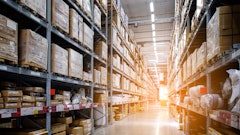
Then the third piece is a warehouse management system that allows us to move our goods from manufacturing to the customer in the most efficient way. We have a saying here that we want to "one-touch" every pound. The drivers of cost in the supply chain are time and touches. The more time something's resident, the more expensive it is; the more times you touch it, the more expensive it is. So we want to one-touch everything straight out of manufacturing. That's why we've developed a warehouse management system that integrates with our order processing system, which allows us to literally capture product as it comes off of our manufacturing lines and move it straight to a truck. We can mix that with a pick-and-put-away capability, and it's all in the same system.
iSource: How about from the manufacturing facility back to the "Earth"? How are you working to improve those processes?
George: One of the reasons we put the warehouse management system in is that we not only manage finished goods with it, but we also manage the material flow into the factory with it. That system allows us to better control material movements and inventory positions, and all that information that's resident can be exchanged with our upstream suppliers. We can plan our production scheduling off of advanced shipping notices (ASNs) from our suppliers, just as most of our customers will plan deployment off of ASNs from us. For us, the real advantage is on the packaging side, because we produce more than 3,000 SKUs [stock-keeping units].
iSource: And are you primarily using EDI [electronic data interchange] with your customers and suppliers?
George: Yes. EDI has become the vehicle for communication that we use, and we're very comfortable with it — and it works.
iSource: AIPC just opened a major new production facility in Arizona. When the company is opening this type of facility, how is the supply chain function involved in the planning for the new facility and the execution side of incorporating that facility into your overall supply chain?
George: In our company, the supply chain drove the decision to build the plant, and it drove the decision on where the plant would be located. We do that through this modeling technique that we have for the supply chain. When we realize that we have a capacity opportunity upon us, we will use our modeling capability to run a number of "what-if" scenarios that will lead us to the lowest total delivered cost, not just for that one location but also for the supply chain as a whole.
We saw tremendous logistical synergies in building a facility in Arizona. For instance, we do a fairly significant business on the West Coast, and we used to service that business out of Excelsior Springs, Mo. Now we service it out of Tolleson, Arizona, and the freight costs are significantly lower. We also found in our due diligence that Arizona is a front-end destination for a lot of freight coming out of California that was going home empty. So by locating to Arizona, we're immediately a back-haul. Numbers that we researched said there were as many as 10,000 trucks going out of Arizona empty each week. We thought we had a great opportunity to put some pasta on those trucks.
iSource: And you were able to put this information into your planning model to run "what-if" scenarios?
George: Yes. In fact, the model contains real operating data for the entire supply chain. We have a person whose full-time job is to maintain and operate that model, and we probably use the model weekly in making a number of decisions.
iSource: What are kinds of decisions that you're making based on the model?
George: We've used it, obviously, for expansion and capacity balancing. We've used it for acquisition. We use it for long-range planning.
iSource: Another issue that I wanted to discuss is how the supply chain contributes to the competitiveness of the company overall, and whether you've been able to increase the company's competitiveness by improving supply chain efficiencies through the use of new technologies and processes.
George: I don't think there is any doubt about that. From AIPC's point of view, the fact that we have a fully integrated operating platform vis-Æ-vis mill, manufacturing and supply chain speaks to how strategic we believe it is. But I think that the competitive contribution the supply chain makes is twofold. One, we're the low-cost producer — and not just a little bit. We're significantly lower cost in the marketplace, and we're constantly looking for new ways to drive cost out of the business. When you look at the scale of AIPC, and our volumes this year in excess of 900 million pounds produced, a fraction of a penny per pound is a lot of money. So any opportunity to shave a half-cent here, a half-cent there repays us with huge dividends. We call it "funding the growth." And that's really the primary purpose for the supply chain initiatives, to drive costs down, to continue to drive our low-cost position in the marketplace and to release funds that can go to driving commercial growth.
In addition, we have very, very strategic relationships from a supply chain point of view with a number of customers. I spend probably 50 percent of my time supporting the commercial side of the business, meeting with customers, talking about how we can find joint synergies and apply them to our business and grow it. We are on a number of advisory panels with customers, looking for different ways to use our tools to help identify opportunities for them.
iSource: How do you balance the various supply chain initiatives ongoing at your customers with the work you are doing to improve your own supply chain?
George: That gets back to our overriding philosophy that our supply chain begins with the customer. By design we have a very nimble supply chain, and we can change and adapt to customer requirements. In many cases, we can actually predict where customers will go with their supply chains, and we try to get there before they do. Consequently, we don't feel the cost pressures that many consumer product companies do.
iSource: What might be an example of that, where you've gone someplace in anticipation of a customer need?
George: The due diligence and the subsequent choice of our warehouse management system were based on a technical capability to cross-dock off of our manufacturing line into a truck. That was an overriding decision point for us on which system to choose, because we anticipate that our customers will continue to shorten their lead-times — if we can truly have the ability to turn an order around at the time of manufacture, we're already there.
iSource: Which WMS do you use?
George: We use Manhattan Associates.
iSource: Are you running an enterprise resource planning (ERP) system there?
George: Well, technically, we're really not fully ERP. We have a BPCS platform, and we have integrated our WMS system into that. We also have some other functional software that we use in other parts of the company that we've interfaced with BPCS.
iSource: What are the challenges or risks that you anticipate when you are implementing any type of new system or process in your supply chain, and how do you deal with those challenges?
George: There's a part of me that says I don't want to tell you, because we've had at least one competitor tackle some technology and have significant problems as a result, which we have benefited from. But that probably wouldn't be fair. [Laughs]
I think our approach is very straightforward. AIPC has the low-cost production platform, the low-cost model in our industry. We only employ just over 600 people. So, obviously, we have to depend on technology to drive our business. But our approach, and what makes us successful, is that we don't build a process around technology. We understand our processes so well that we identify the process improvement and the application, and then we go and find the technology — and we don't Alpha or Beta any technology. If the processes are well defined, we can lay the technology on top of them and not go through some of the pain. That's not to say that there isn't pain — any installation and integration of technology is going to come with some issues. But we have very stringent return on investment criteria for any technology purchase, and the savings have got to be real, and the savings have got to be incorporated into our financial statements.
iSource: Do you have a preference for going outside to buy technology or building your own?
George: We go outside.
iSource: How come?
George: We're in the pasta business. We don't want to be in the technology business. And we're very good users, but we don't want to employ an IT infrastructure. I came out of a background with some pretty aggressive technology initiatives, and I think that it has taken a while for some of those initiatives to take hold. But I also have seen, not just in my prior life but out in marketplace, how so many companies employ technology, but then they also have to employ an infrastructure to support it. And that doesn't make much sense to us. We take the approach that the technology shouldn't require a pit crew to keep it going.
iSource: Finally, you've worked at Colgate Palmolive's pet food subsidiary, Hill's Pet Nutrition. What did you bring with you from that environment to your new job at AIPC?
George: Colgate's a very, very fine company, and they employ a technology strategy — a technology platform — that's very strategic. They have wrestled with things that most companies don't. They had to integrate businesses all over the world. They employed SAP, and what has made them successful was a very strict discipline to implementing SAP, and I think that's invaluable. You decide what you want to do with it and you adhere to the standard until you get it operational. Only then do you begin to fine-tune. Colgate has proved that time and time again through their installations. And I think they are also very good at supply chain management overall, using a philosophy that is supported by technology, and that's been very helpful for me.